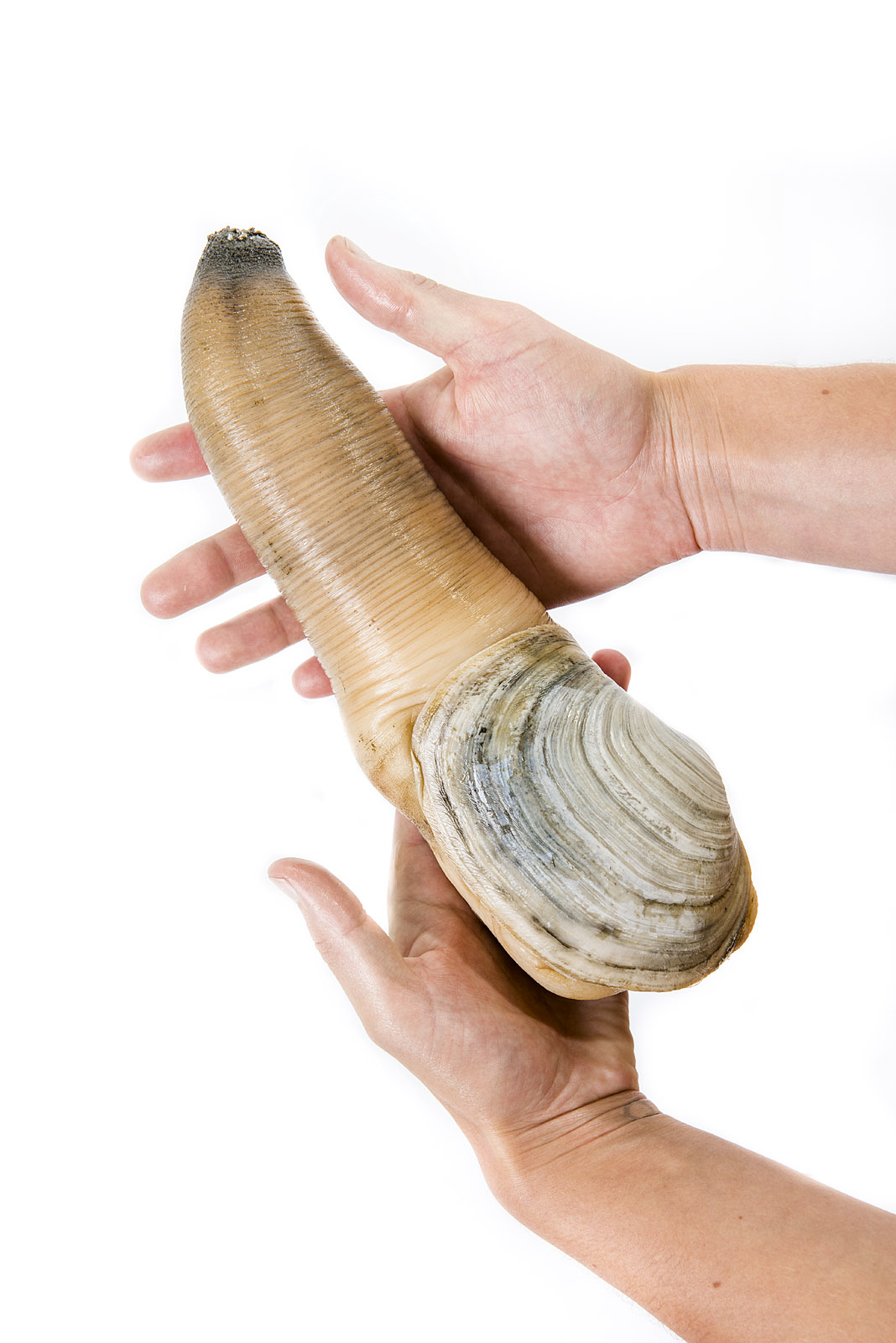
Anatomy of a long-lived giant
The Pacific geoduck (Panopea generosa) is the world's largest burrowing clam. Native to the coastal waters of the North Pacific from Alaska to Baja California, it thrives in the soft, muddy seabeds of Puget Sound. An adult geoduck remains stationary for its entire life, buried up to a meter (3.3 feet) deep in the sediment. The only visible part is the tip of its massive siphon, which can stretch over a meter in length to the surface. This siphon contains two tubes: one draws in seawater to filter for phytoplankton and oxygen, and the other expels waste.
The clam's body is far too large to retract into its shell, which typically measures between 15 and 20 centimeters (about 6 to 8 inches). While the average weight is around 1.1 kilograms (2.5 pounds), some individuals have reached over 4 kilograms (9 pounds). This immense size and deep burrow provide excellent protection from predators. Once a geoduck is a few years old and has dug itself deep into the substrate, its primary threats are sea otters, dogfish, and certain sea stars that can attack the exposed siphon. This secure lifestyle is important in its extraordinary longevity.
A life measured in centuries
The average lifespan of a geoduck is about 140 years, but individuals have been recorded living as long as 168 and even 179 years. Scientists can determine a geoduck's age by counting the annual growth rings on its shell, a process similar to dendrochronology in trees. These rings record past marine conditions.
Growth is rapid for the first 10 to 15 years, after which increases in shell length stop while the body continues to gain mass. Geoducks become sexually mature at around three years of age and reproduce via broadcast spawning, releasing their gametes into the water. A female can produce up to five billion eggs over her century-long lifespan, though mortality rates for larvae and juveniles are very high. The larval stage is planktonic for several weeks before the juvenile clams settle onto the seafloor and begin to burrow, seeking the deep, sandy area where they will spend the remainder of their long lives.