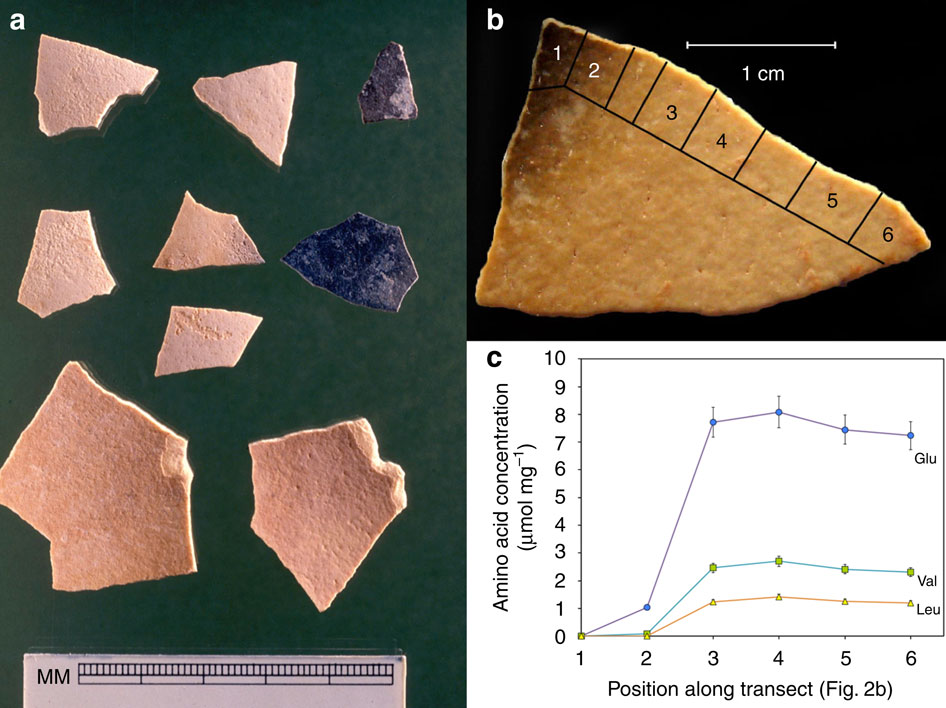
Burned eggshell fragments proving humans cooked these giant bird eggs 50,000 years ago. Possibly contributing to their extinction.
Miller, Gifford; Magee, John; Smith, Mike; Spooner, Nigel; Baynes, Alexander; Lehman, Scott; Fogel, Marilyn; Johnston, Harvey; Williams, Doug; Clark, Peter; Florian, Christopher; Holst, Richard & DeVogel, Stephen, CC BY 4.0
A 50,000-year-old meal
Across more than 200 sites in Australia, archaeologists have found thousands of peculiar fossils: blackened and broken pieces of eggshell. These are the remains of eggs laid by Genyornis newtoni, a flightless bird that stood over two meters tall and weighed between 220 and 240 kilograms. This giant, heavily built animal, the last of Australia's "mihirungs" or "thunder birds," disappeared shortly after the arrival of humans on the continent. The scattered eggshell fragments are the main evidence of interaction between humans and this extinct megafauna.
The eggs themselves were formidable. Each one was roughly the size of a cantaloupe, weighing about 1.5 kilograms, which is nearly twice the volume of an emu's egg. Analysis of protein sequences preserved inside the mineral crystals of the shells confirmed they belonged to Genyornis. This was done because the ancient DNA had long since degraded in the hot Australian climate. The widespread discovery of these shells suggests that early Australians occasionally stumbled upon nests; they systematically harvested the eggs across the continent.
Reading the burn marks
The explanation for this discovery lies in how the shells were burned. Scientists analyzed the fragments and found that the heat damage was inconsistent with natural events like wildfires. Wildfires burn hot and uniformly, but the Genyornis shells show a distinct temperature gradient. Some parts of a single fragment are heavily charred while other parts are barely heated, which is consistent with being placed in or near the embers of a small cooking fire. Researchers found many burnt fragments in tight clusters just a few meters in diameter, exactly where a small campfire might have been.
Three different dating methods, including radiocarbon dating and optically stimulated luminescence, place the burnt shells in a narrow time window between 53,900 and 43,400 years ago. This period aligns precisely with the arrival of humans in Australia and the rapid disappearance of Genyornis. While there is no direct archaeological evidence of humans hunting the adult birds, the systematic theft and cooking of their eggs would have severely impacted their ability to reproduce. This over-exploitation of eggs is considered a factor that pushed the last of the thunder birds into extinction.
💡Fun Facts
A single *Genyornis* egg weighed about 1.5 kg (3.5 lbs) and was the size of a cantaloupe.
Despite its emu-like appearance, *Genyornis* was not a ratite. It belonged to the Anseriformes, the same group as modern ducks and geese.
Scientists determined the eggs were cooked by analyzing the specific way amino acids in the shell protein were damaged by heat.
The first fossils of *Genyornis newtoni* were described in 1896 from remains found at Lake Callabonna in South Australia.
The fossil sites are remote and not publicly accessible. To see *Genyornis* and other megafauna fossils, visit the South Australian Museum. Open daily 10am - 5pm.