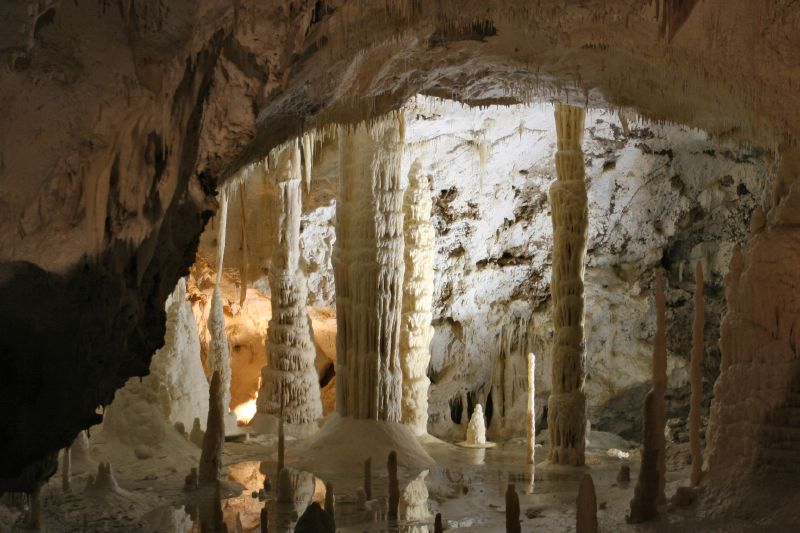
An ecosystem powered by poison
Deep beneath the Apennine Mountains of Italy lies an ecosystem that runs on toxic gas. The Frasassi Caves, a vast karst system discovered on September 25, 1971, are a geological wonder and a scientific laboratory to understand how life can exist in extreme environments. Unlike most caves formed by carbonic acid from surface water, Frasassi's passages were carved out from below by a more aggressive agent: sulfuric acid. This process, known as sulfuric acid speleogenesis, began when deep, hydrogen sulfide (H₂S)-rich groundwater flowed upwards, mixing with oxygenated water near the surface. The resulting chemical reaction produced sulfuric acid, which dissolved the limestone and created immense chambers like the Ancona Abyss—a cavity so large it could comfortably contain the Milan Cathedral.
This unique geology creates a bizarre ecology. In the deeper, non-public levels of the cave, sulfidic streams flow in total darkness. These waters are inhospitable to most life, but here, certain microorganisms flourish. Instead of photosynthesis, the base of this food web relies on chemosynthesis. Bacteria, forming thick, white, stringy biofilms on the stream beds, harness chemical energy by oxidizing the hydrogen sulfide. This process creates organic matter and supports a surprisingly diverse community of invertebrates, including at least 12 endemic species of cave-adapted crustaceans and insects.
A model for extraterrestrial oceans
The strange, sunless world of Frasassi is a compelling analog for life on other worlds. Jupiter's moon Europa is believed to harbor a vast liquid water ocean beneath its icy shell, a place where sunlight could never reach. Any life in that ocean would require an alternative energy source, possibly from hydrothermal vents releasing chemical compounds like hydrogen sulfide—a process mirrored in Frasassi. By studying the chemosynthetic bacteria in the cave, researchers gain insight into the metabolic pathways that could potentially support extraterrestrial organisms.
The microbial communities in Frasassi are specialized. In some areas, hanging biofilms nicknamed "snottites" drip sulfuric acid with a pH between 0 and 1. These communities are dominated by a few key types of extremophilic bacteria, primarily related to Acidithiobacillus. Researchers analyzing the cave's geochemistry have found that the microbes above the water are more important for cave formation than those below it. Gaseous hydrogen sulfide escapes the water and is consumed by microbes on the damp cave walls, producing corrosive sulfuric acid that dissolves the limestone and enlarges the caverns. This active, microbially-driven geology provides a model for how life could shape its environment on a planetary scale, far from the energy of a star.