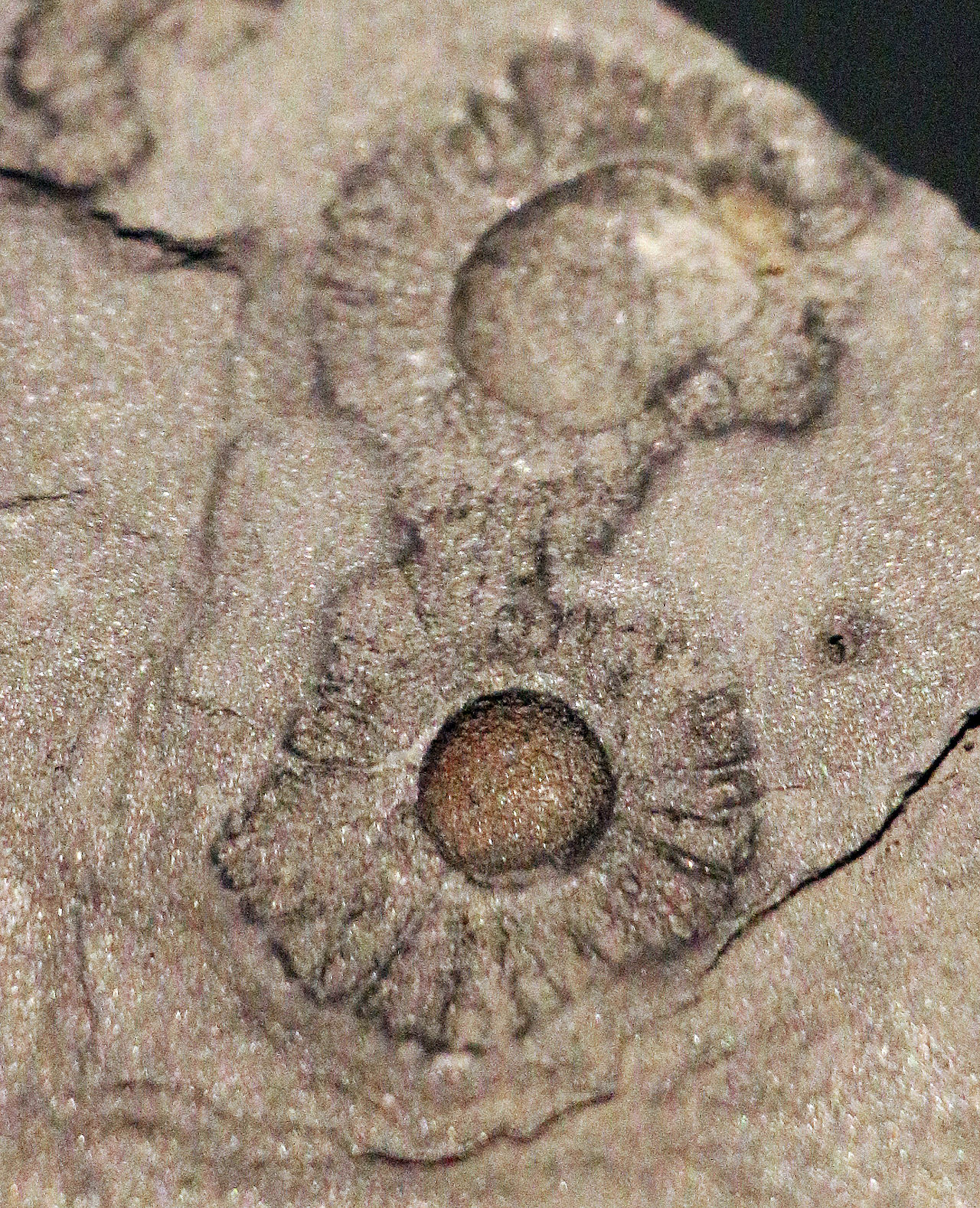
An evolutionary dress rehearsal
In the black shale formations near Franceville, Gabon, geologists have uncovered a collection of fossils that challenge the timeline of life on Earth. These are the Francevillian biota, and at 2.1 billion years old, they are the oldest known examples of macroscopic, multicellular organisms. Discovered in 2008 by geologist Abderrazak El Albani, these fossils are found in dense clusters, with as many as 40 individuals per square meter.
The organisms have a variety of forms. Shapes include flattened scalloped discs, elongated rods, and complex lobed structures, with some reaching up to 17 centimeters in size. Advanced imaging techniques like X-ray microtomography reveal three-dimensional, organized structures, and coordinated growth and cell-to-cell communication. Some specimens even resemble the migratory slug phase of modern slime molds. Adding to the mystery, fossilized tunnels up to 170 mm long and 6 mm wide have been found in the same rock layers, indicating that some of these organisms were capable of movement.
The biological origin of these structures was initially debated; some scientists saying they were inorganic mineral formations called pseudofossils. However, geochemical analysis showing uniform sulfur isotope ratios and the presence of steranes—molecular fossils associated with eukaryotes—supports their biological nature.
A brief period of growth
The Francevillian biota appeared during a unique period in Earth's history. Their existence coincides with the Lomagundi-Jatuli Event, the most significant and longest-lasting positive carbon isotope excursion in the planet's history. This event, which occurred between roughly 2.3 and 2.1 billion years ago, was linked to the Great Oxidation Event, which saw the first significant rise of atmospheric oxygen. The fossils are found in sediments that formed in a calm, shallow marine delta. This temporary oxygenation of the oceans likely provided the necessary conditions for these more complex life forms to evolve and flourish.
This evolutionary experiment, however, was short-lived. As the Lomagundi-Jatuli Event ended, global oxygen levels plummeted, and the Francevillian biota vanished from the fossil record. Complex, macroscopic life would not reappear for another 1.5 billion years, a period often called the "Boring Billion." The fossils in Gabon represent a fascinating, but ultimately failed, first attempt at large-scale multicellularity, leaving a deep gap in the story of life.