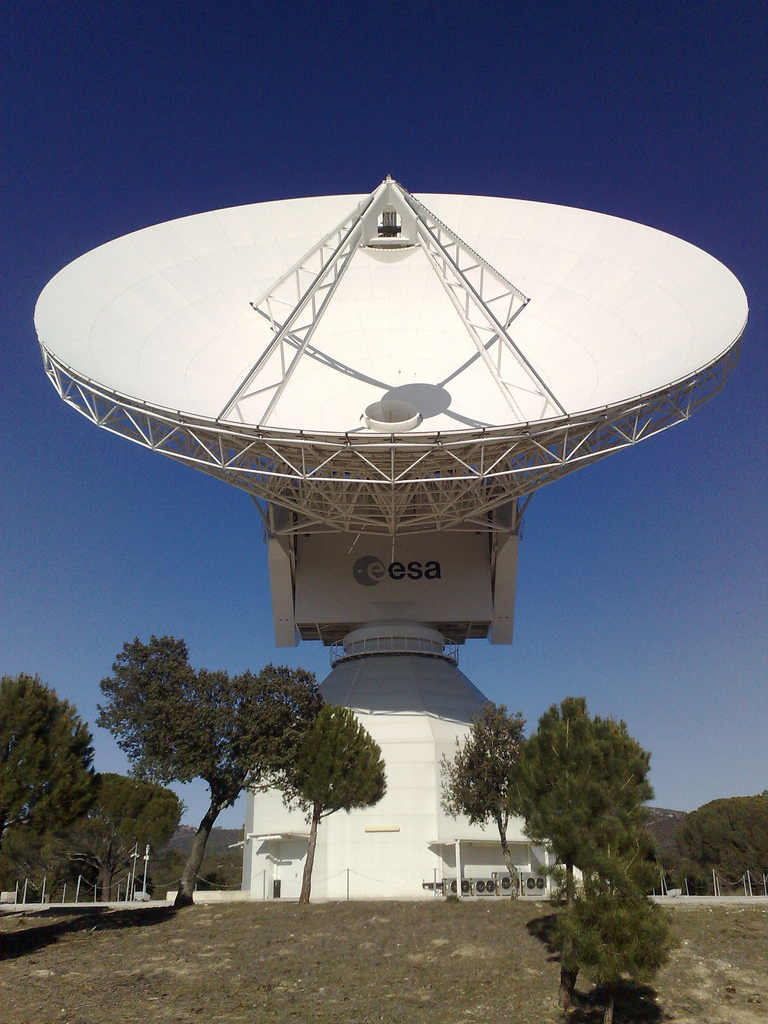
A critical node in a global network
The Cebreros Station, designated Deep Space Antenna 2 (DSA 2), is a component of the European Space Agency's ESTRACK network. This global system of ground stations provides the communication links between distant spacecraft and the European Space Operations Centre (ESOC) in Darmstadt, Germany. The 35-meter antenna at Cebreros works with its sister stations in New Norcia, Australia (DSA 1) and Malargüe, Argentina (DSA 3). Together, these three stations are positioned approximately 120 degrees apart in longitude, ensuring that any spacecraft can be continuously tracked as the Earth rotates.
The entire structure at Cebreros stands 40 meters high and has a total weight of about 620 tonnes. To ensure stability, its foundations are anchored 20 meters deep into the ground. Construction on the station began in early 2004, and it was officially inaugurated in September 2005. Its first operational task was to receive a signal from the Venus Express spacecraft on November 10, 2005. The station's location in a rural area, 77 km west of Madrid, was chosen to avoid the radioelectric interference common in urban centers. The site was previously used by NASA for a tracking station in the 1960s and 1970s.
Precision engineering for faint signals
Communicating across hundreds of millions of kilometers requires extreme precision and sensitivity. The Cebreros antenna's pointing accuracy has a maximum error of just six millidegrees, which is ten times more precise than standard 15-meter tracking antennas. This accuracy is maintained by a system of 250 temperature sensors distributed across the structure, which automatically compensate for tiny expansions and contractions caused by temperature changes. The antenna can move at a speed of one degree per second on both its axes.
To detect the incredibly faint signals arriving from deep space, the station's low-noise amplifiers are cryogenically cooled with helium to a temperature of 15 Kelvin (-258°C). This extreme cold minimizes thermal noise in the receiver system. The station primarily receives signals in the X-band and the higher-frequency Ka-band (31.8–32.3 GHz), which allows for higher data return rates. For sending commands to spacecraft, it uses powerful 20-kilowatt X-band transmitters. The station has provided communication support for numerous missions, including Mars Express, Rosetta, Venus Express, Gaia, BepiColombo, and Solar Orbiter. While highly automated and typically operated remotely from Germany, the station is manned during critical mission phases like launches.