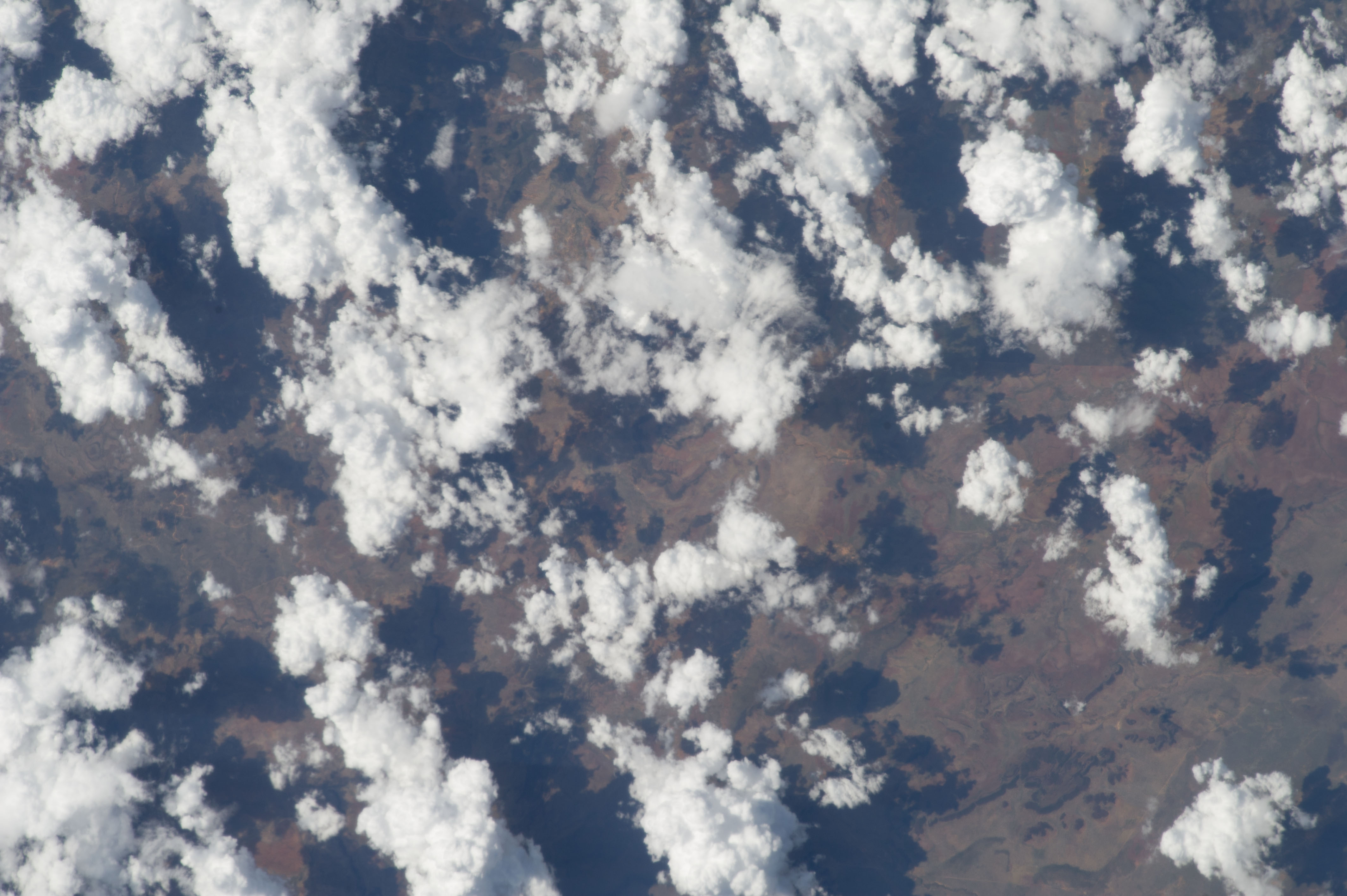
Rocks recording the Boring Billion, from 1.8 to 0.8 billion years ago when evolution stalled. Ocean chemistry stayed stable, oxygen stayed low, and life stayed simple for a billion years. These rocks explain why complex life took so long to appear, trapped in a planetary equilibrium hard to break.
Earth Science and Remote Sensing Unit, Lyndon B. Johnson Space Center, Public domain
A planet held in stasis
In the remote expanse of the Northern Territory, ancient sedimentary rocks hold the story of the "Boring Billion," a period from roughly 1.8 to 0.8 billion years ago when Earth's evolution seemingly hit a prolonged pause. Geological formations, such as the extensive Roper Group in the McArthur Basin, show this era of stability. These rocks, primarily fine-grained shales and mudrocks, tell of calm, low-energy seas that persisted for a billion years.
This period is defined by deep environmental and tectonic stasis. Following the Great Oxidation Event, atmospheric oxygen levels flatlined at a mere 0.1% to 10% of today's concentrations. The supercontinents of Columbia (or Nuna) and Rodinia dominated the planet, their relative stability limiting the tectonic activity that drives environmental change. This lack of mountain-building and continental rifting meant fewer nutrients, like phosphorus, were washed into the oceans to fuel the biosphere. The result was a planetary equilibrium that kept life simple and small.
Life in the slow lane
During this billion-year interval, life consisted mainly of simple organisms. Prokaryotic cyanobacteria were the dominant lifeforms, while the first eukaryotes—cells with a nucleus—had appeared but failed to diversify. The fossil record shows that while these early eukaryotes existed, their evolution progressed at an incredibly slow rate. The oceans were likely stratified and oxygen-poor, with sulfur-loving microbes potentially thriving in the depths, creating toxic, sulfidic conditions.
This long period of apparent boredom may have been a necessary incubation for future complexity. Inside eukaryotic cells, fundamental innovations were slowly taking shape, including the development of organelles and new ways to package DNA. The "Boring Billion" finally ended around 800 million years ago. The breakup of the supercontinent Rodinia spurred volcanic activity, altered ocean currents, and released a new supply of nutrients into the water. This tectonic upheaval, coupled with a subsequent rise in oxygen, broke the long-standing equilibrium and set the stage for the eventual explosion of complex animal life.
💡Fun Facts
An Earth day during the Boring Billion was shorter, lasting only about 21 hours.
The Moon was closer to Earth, resulting in more powerful tides.
Stromatolites, layered structures built by cyanobacteria, reached their peak abundance and diversity during this era.
Despite the name, this period saw the evolution of sexual reproduction, a major development for future life.
The geological sites are in remote, unfenced wilderness and are accessible at any time, weather and road conditions permitting.
Admission
Free to access the general region; specific national parks may have entry fees.
Accessibility
Accessing these remote geological areas requires a high-clearance 4WD vehicle, extensive preparation, and self-sufficiency with fuel, water, and emergency supplies. Terrain is rugged and undeveloped.