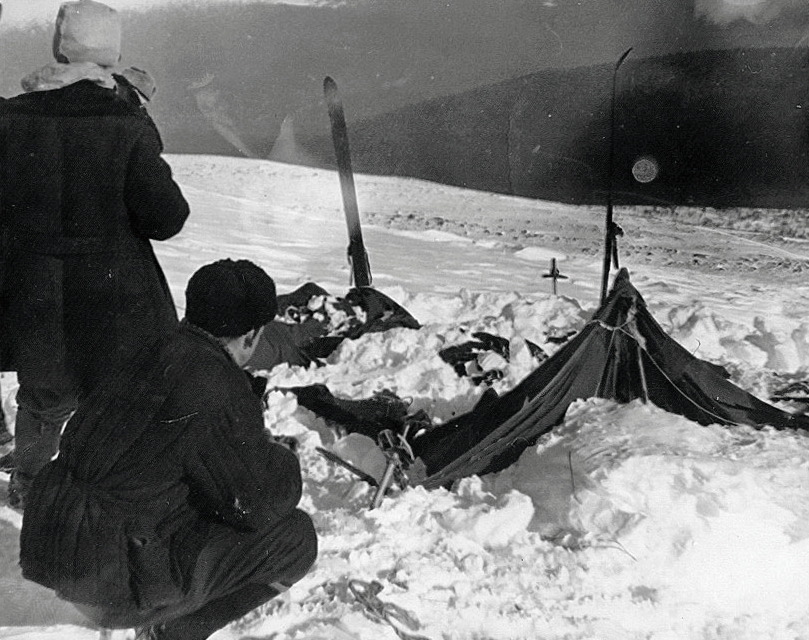
In 1959, an elite group of Soviet trekkers died under circumstances so bizarre. Mutilation, internal injuries, and radiation traces. That official explanations still fall short.
AnonymousUnknown author / Soviet investigators, Public domain
A Scene of Scientific Confusion
On February 26, 1959, a search party discovered the abandoned camp of nine experienced ski hikers on the eastern slope of Kholat Syakhl, a mountain in the northern Ural Mountains. The tent, partially collapsed and covered in snow, had been sliced open from the inside. All the group's belongings, including their shoes and winter gear, were left behind. Footprints from nine individuals, some wearing only socks or a single shoe, led away from the camp toward a nearby forest 1.5 kilometers away.
The first two bodies were found under a large Siberian pine tree, dressed only in their underwear. Three more, including group leader Igor Dyatlov, were discovered between the tree and the campsite, in poses that suggested they were to return. It took more than two months for the remaining four hikers to be found, buried under four meters of snow in a ravine. The initial investigation concluded that six of the hikers died from hypothermia. The other three presented a forensic puzzle: they had sustained severe internal trauma without corresponding external injuries. One victim, Nicolas Thibeaux-Brignolles, had a major skull fracture. Lyudmila Dubinina and Semyon Zolotaryov had major chest fractures, the force of which was compared to that of a car crash. Dubinina was also found without her tongue, eyes, and part of her lips.
Compelling Natural Forces
The original 1959 Soviet investigation closed the case by attributing the deaths to a "compelling natural force". The files were sent to a secret archive, fueling decades of speculation. Theories ranged from military weapons testing, spurred by the discovery of low-level radiation on some of the hikers' clothing, to an attack by the local Mansi people, which was quickly dismissed. Other hypotheses included infrasound-induced panic, where low-frequency sound waves generated by wind could cause psychological distress.
In 2019, Russian authorities reopened the investigation. Their conclusion, announced in 2020, pointed to a slab avalanche. This theory suggests a large plate of snow slid down onto the tent, causing the initial injuries and forcing the group to make a panicked escape into temperatures as low as -40°C. A 2021 study published in Communications Earth & Environment supported this idea, using computer modeling to show how a small, delayed slab avalanche could have occurred on the relatively shallow slope after the hikers cut into the snowpack to pitch their tent. The model demonstrated that the impact from a slab of dense snow could produce injuries consistent with the autopsy reports. The subsequent soft tissue damage on the bodies found in the ravine is attributed to decomposition in running water and scavenging by small animals.
💡Fun Facts
The name of the mountain, Kholat Syakhl, translates from the local Mansi language as "Dead Mountain," a name given due to the scarcity of game in the area, not because of any prior human fatalities.
One of the original ten members of the expedition, Yuri Yudin, turned back early in the trip due to illness, a decision that saved his life.
Low levels of radiation detected on two victims' clothing were likely from thorium used in camping lanterns or from one hiker's previous work at a nuclear facility.
Another group of hikers camping about 50 kilometers south reported seeing strange orange spheres in the sky on the night of the incident.
The area is a remote, natural wilderness and is always accessible, but only recommended for experienced trekkers with proper gear, especially during winter.
Admission
Free
Accessibility
The pass is located in a remote area of the Ural Mountains. Access requires significant trekking, often by ski or snowmobile, over difficult terrain. There are no paved roads or facilities.