Seeing with sound
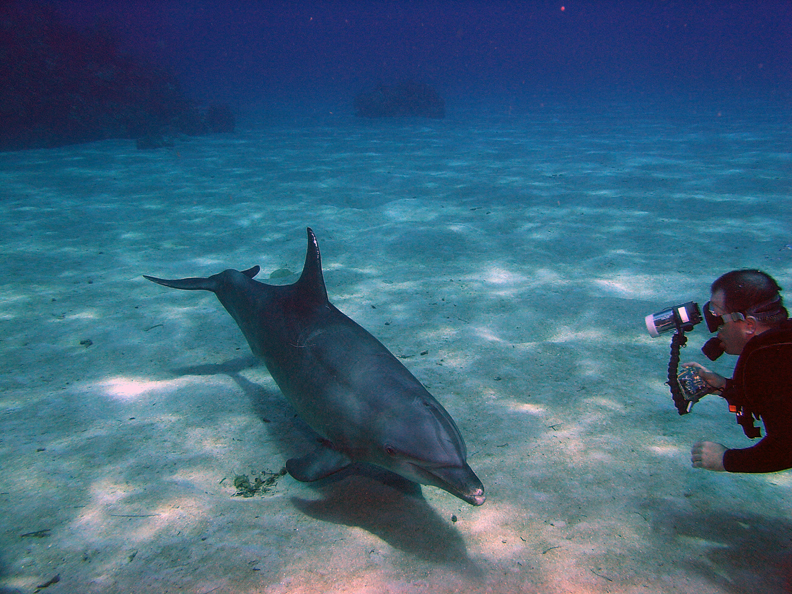
Toothed whales (Odontoceti) navigate and hunt in dark or murky water using biological sonar, or echolocation. The bottlenose dolphin (Tursiops truncatus), a focus of research at the Roatán Institute for Marine Sciences (RIMS), shows this ability. The process begins when a dolphin produces high-frequency clicks using structures called phonic lips, located just under its blowhole. These clicks, which can range from 40 to 150 kilohertz (kHz), are then focused by a fatty, lens-shaped organ in the forehead called the melon. The melon directs the sound into a beam, which the dolphin can aim at objects of interest.
Sound travels about 4.5 times faster in water than in air. When the dolphin's sound waves strike an object, they bounce back as an echo. The returning sound waves are not received by the outer ears, but primarily through fat-filled cavities in the lower jaw. These channels conduct the vibrations to the middle and inner ear, where they are converted into nerve impulses and sent to the brain. The brain processes these impulses, translating them into a detailed acoustic "image." This process allows dolphins to determine an object's size, shape, distance, speed, and even its internal structure. The effective range for this detailed imaging is typically between 5 and 200 meters.
A shared acoustic world
The hypothesis of acoustic image transfer suggests that dolphins might share these "sound pictures." Research indicates that a second dolphin can listen to the returning echoes from another dolphin's echolocation clicks and successfully identify the object being scanned. This suggests a capacity for "echoic eavesdropping," where one dolphin gains environmental information from the sonar activity of another.
The idea of direct image transmission is more speculative but is grounded in the physics of sound and dolphin biology. One research project, led by Jack Kassewitz of SpeakDolphin.com, used an instrument called a CymaScope to translate recorded dolphin echolocation signals into visual images. The CymaScope works by imprinting sonic vibrations onto a membrane of ultra-pure water, creating a visual representation of the sound's structure. In one experiment, the echolocation clicks of a dolphin scanning a submerged man were recorded. The CymaScope translated these recordings into a 2D image that was recognizably human. This experiment suggests that the information contained within the echoes is detailed enough to reconstruct a visual analog.
This "sono-pictorial" language theory proposes that dolphins can essentially send pictures to each other. One dolphin could actively echolocate an object while another passively receives the detailed echo. Neurophysiological studies show that dolphins' auditory nerves are closely linked to their visual cortex, supporting the idea that they can "see" with sound. The complex, rapid click trains, sometimes exceeding 500 clicks per second, could carry this holographic-like information, allowing one dolphin to share its acoustic perception of the world with another.