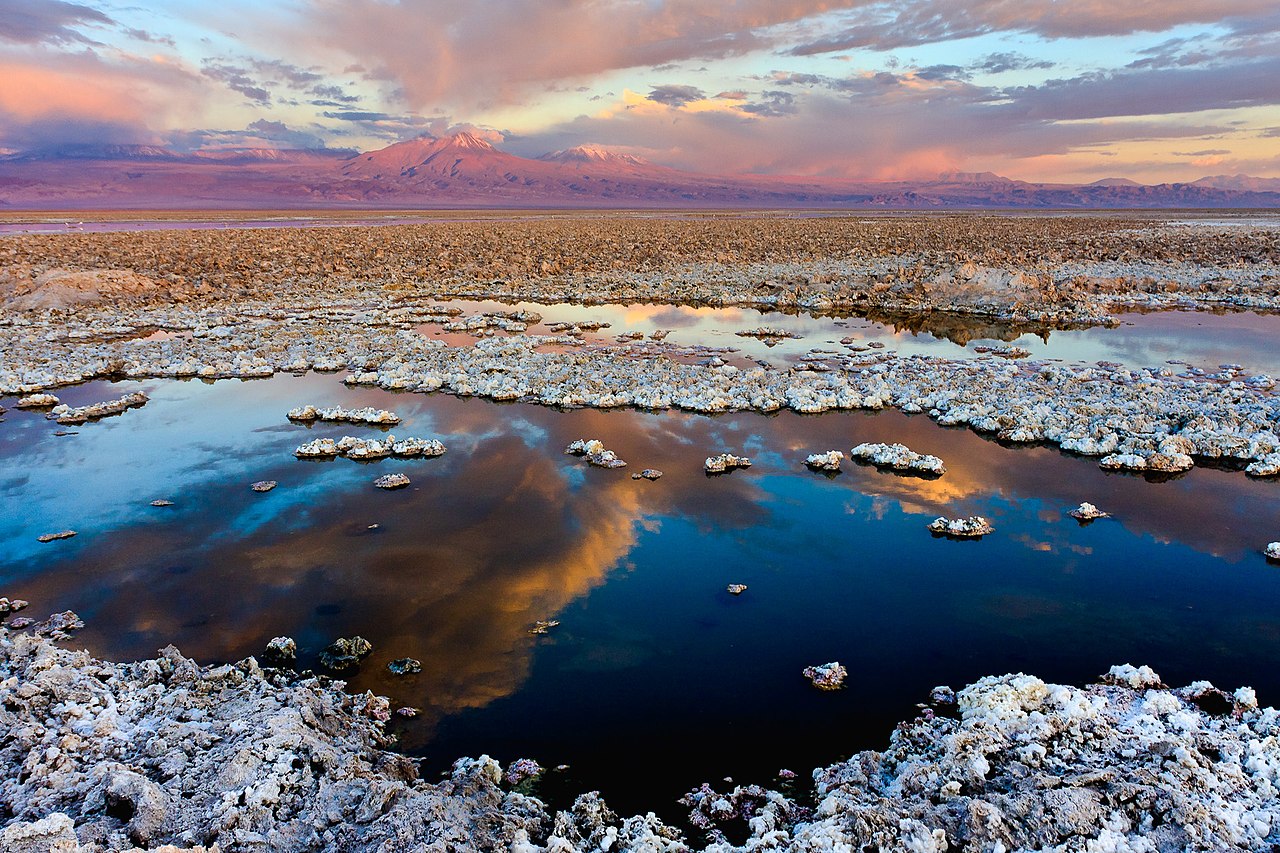
Solar evaporation ponds extract lithium from brine in salt flats. Chile holds 52% of global reserves. The extraction uses no energy but consumes scarce water.
Francesco Mocellin, CC BY-SA 3.0, via Wikimedia Commons
Earth's largest lithium battery
The Salar de Atacama is the largest salt flat in Chile, a 3,000-square-kilometer basin enclosed by the Andes mountains. This is not a conventional mine, but a massive, subterranean reservoir of mineral-rich brine. Over geologic time, lithium leached from volcanic rocks has washed down into this closed basin, where the only exit for water is evaporation. Beneath a thick, rough crust of sodium chloride lies a brine containing the world's largest and purest active source of lithium. This brine holds a lithium concentration of around 1,800 to 2,700 parts per million, the highest known in the world.
The extreme conditions of the Atacama Desert make this resource economically viable. The region is one of the driest places on Earth, with an average annual rainfall of less than 30 mm and an evaporation rate of 3,500 mm per year. This climate powers a vast industrial process of solar evaporation. Brine is pumped from beneath the salt crust into a sprawling network of shallow ponds. As the intense desert sun and dry winds evaporate the water, the salts become increasingly concentrated. This process unfolds over 12 to 18 months, as the brine is moved through a series of ponds. Different salts precipitate out at different stages, leaving behind a final solution with a lithium concentration as high as 6%.
A landscape of chemical reactions
The evaporation ponds create a stunning, otherworldly area visible from space. The bright colors, electric blue, turquoise, and yellow-green, are not artificial. They are shows the chemical processes happening within. Each color represents a different stage of evaporation and mineral concentration. As water diminishes, the ratio of dissolved salts changes, which in turn alters the color of the ponds. The final ponds, rich in concentrated lithium chloride, often appear a distinctive yellow-green.
This method of extraction, while energy-efficient, has a significant environmental footprint. The process is water-intensive, evaporating enormous volumes of brine from a closed basin in a region already facing extreme water scarcity. Pumping massive quantities of brine affects the delicate hydrological balance of the salar, which supports unique ecosystems. The area is an important habitat for several species, including three types of flamingos: the Andean, Chilean, and James's flamingo. These birds feed on brine shrimp and algae that thrive in the saline lagoons, and changes in water levels and salinity can disrupt their food source. The extraction of lithium therefore creates a direct conflict between the global demand for green energy and the preservation of a fragile desert ecosystem.
💡Fun Facts
The vivid colors of the evaporation ponds, from deep blue to bright green, are caused by the changing mineral concentrations as water evaporates.
The Salar de Atacama hosts three of the world's six flamingo species: Andean, Chilean, and James's flamingos.
The Atacama Desert is one of the best places on Earth for astronomy due to its high altitude and clear skies.
The salt crust is so thick and rough that it creates a jagged, inhospitable surface, unlike the smooth salt flats found in other parts of the world.
The general landscape is always accessible. Portions fall within Los Flamencos National Reserve, which is open daily, typically from 9:00 AM to 6:00 PM. Industrial mining areas are not open to the public.
Admission
Access to the general Salar is free. Entry to specific sites within Los Flamencos National Reserve, like the Chaxa Lagoon, requires a ticket purchased in advance.
Accessibility
Terrain is rugged and often unpaved. A 4x4 vehicle is highly recommended. The high altitude (2,300 meters) can affect visitors.