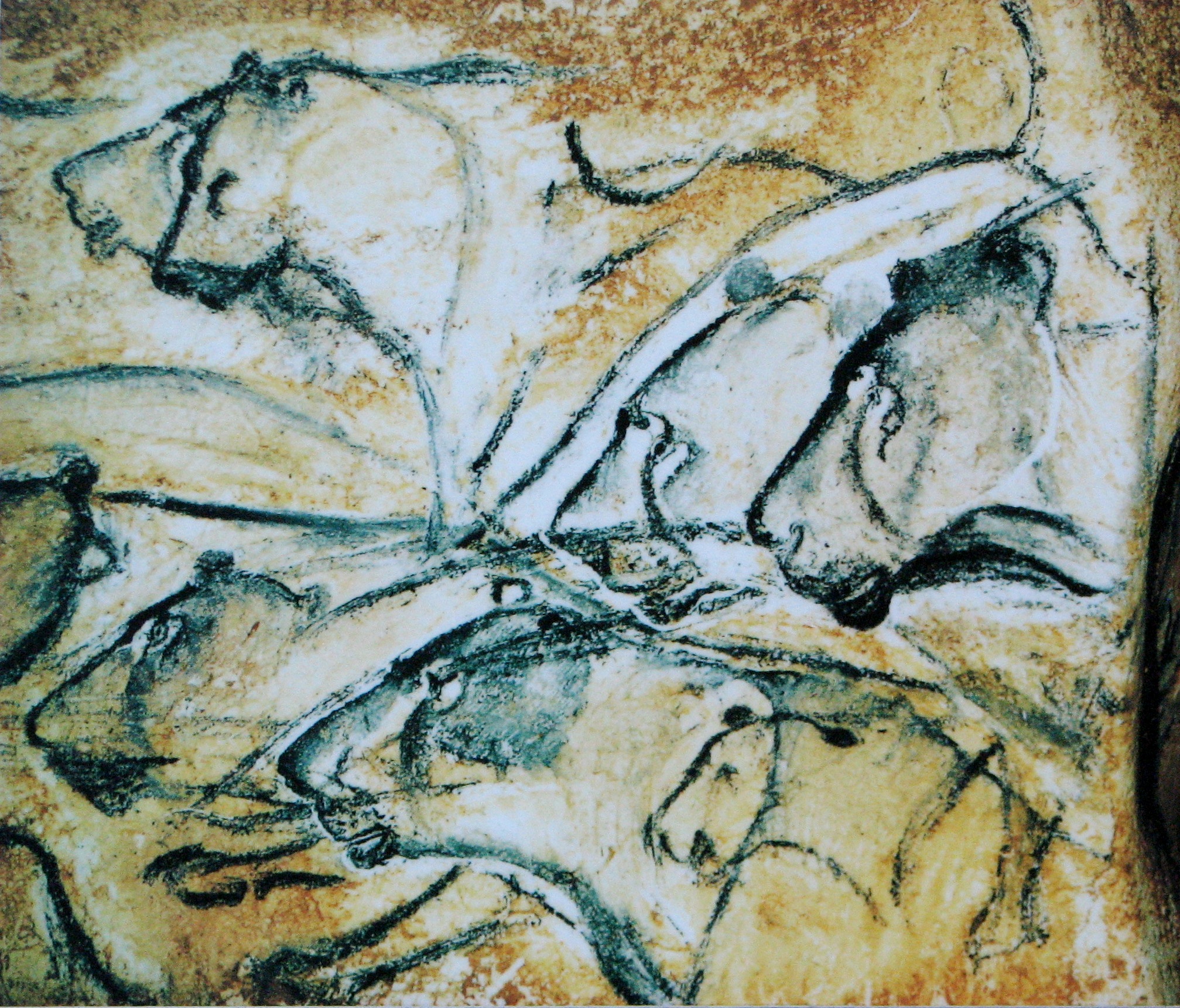
An Ice Age time capsule
On December 18, 1994, a team of three speleologists led by Jean-Marie Chauvet felt a slight draft of air coming from a small opening in a cliffside in the Ardèche region of southern France. After clearing away rocks, they entered a cave system that had been sealed off from the world by a rockfall an estimated 29,000 years ago. Inside, they found a pristine Ice Age environment, complete with the fossilized bones of cave bears, wolves, and ibex. The soft clay floor still held the paw prints of bears and the footprints of a small child.
The most significant discovery was on the walls. The cave contains over 1,000 images, some of the oldest and most well-preserved figurative paintings ever found. Radiocarbon dating of the charcoal used in the drawings—made mostly from Scots pine—shows two distinct periods of human activity. The majority of the artwork dates to the Aurignacian period, between 37,000 and 33,500 years ago. A second, later period of human presence occurred between 31,000 and 28,000 years ago, leaving behind torch marks and the child's footprints. The cave's stable interior climate, sealed by the ancient rockfall, preserved the art in near-perfect condition.
A gallery of prehistoric predators
The artists of Chauvet depicted at least 13 different species. The art is unusual compared to other Paleolithic caves because it features a high number of predatory animals. Lions, mammoths, and rhinoceroses are the dominant figures, accounting for 63 percent of the identified animals. Cave lions, panthers, bears, and even cave hyenas cover the walls. Herbivores like horses, bison, aurochs (an extinct species of ox), and the giant deer Megaloceros are also present, but in smaller numbers. These were not the animals typically hunted, which suggests the art was not a record of daily meals.
The techniques are remarkably advanced. To create their images, the artists would first scrape the cave walls clear of debris, creating a smoother, lighter canvas. They used charcoal for black outlines and red ochre for color. shading, which was previously unknown in art of this era, gives the figures volume and relief. Some panels show animals with multiple overlapping legs and heads, creating a "motion blur" effect that suggests movement, especially under the flickering light of a torch. The artists also used the natural contours and relief of the cave walls to give their subjects a three-dimensional quality. In one instance, a series of red dots made by a single person's palm form the shape of a mammoth, an early form of pointillism.
Reading the walls
Beyond the animal figures, the cave holds other clues. The floor is littered with the skulls and bones of cave bears, which hibernated in the chambers. In one chamber, a bear skull was deliberately placed on a large, flat rock, indicating ritual activity. Torch marks on the walls reveal how the artists lit their workspace, and flint points and other tools have also been found.
The cave also contains abstract markings, hand stencils, and partial handprints made with red ochre. One images is a drawing that depicts a volcanic eruption. Geologists have confirmed that volcanoes in the nearby Bas-Vivarais region were active around the time the paintings were made, about 35 kilometers away. If this interpretation is correct, the spray-shaped signs in Chauvet cave are the oldest known depiction of a volcanic eruption by more than 28,000 years.