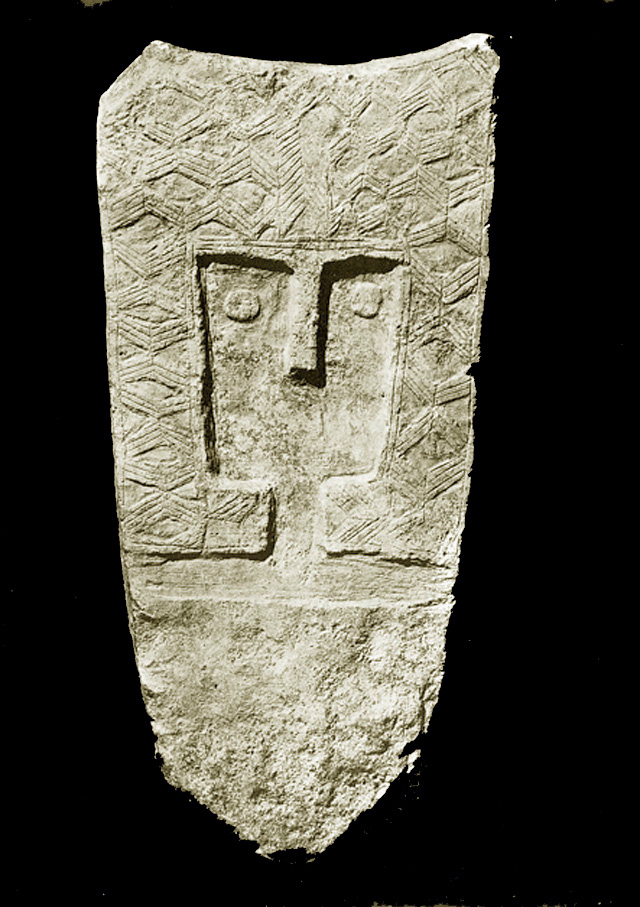
The Camp of Chassey
High on a limestone spur in Burgundy is the Camp de Chassey, a site that names an entire prehistoric culture. This location is the "type site" for the Chasséen (or Chassey) culture, a Late Neolithic society that existed from roughly 4500 to 3500 BC. First identified here, the Chasséen cultural pattern, especially its pottery, became common, spreading across the plains and plateaus of modern-day France, from the Seine basin in the north to Occitanie in the south.
The site itself is a naturally fortified plateau, a 700-meter-long promontory with steep cliffs up to 10 meters high on its east and west sides, providing a strong defensive position. The people who lived here were sedentary farmers and herders. They cultivated rye, millet, apples, and pears while raising sheep, goats, oxen, and pigs. Their settlements consisted of huts organized into small villages, which could house between 100 and 400 people. Excavations have uncovered pottery and sophisticated flint tools, arrowheads, and stone axes, showing a mastery of stone technology before the advent of metal.
A Ceramic Signature
Chasséen pottery is distinctive for its quality and form. The ceramics are often fine, well-fired, and feature a dark, burnished surface. While much of the everyday pottery was plain, specific forms define the culture. These include round-bottomed bowls, baggy or hemispherical bowls, and sharply angled "carinated" bowls.
One of the most characteristic, though rarer, items is the vase-support. This footed dish, found mostly in the northern extent of the Chasséen territory, likely functioned as a stand for other round-bottomed vessels. Some Chasséen pottery displays incised geometric decorations, such as triangles or chevrons, which were sometimes filled with a white or red paste to make the patterns stand out. Another recurring feature is the presence of "pan-pipe" shaped lugs or handles on some vessels. This ceramic style was so successful that it was adopted and adapted over a vast area, with Chasséen artifacts found in the Paris Basin, southern France, and even influencing neighboring cultures in Switzerland and northern Italy.