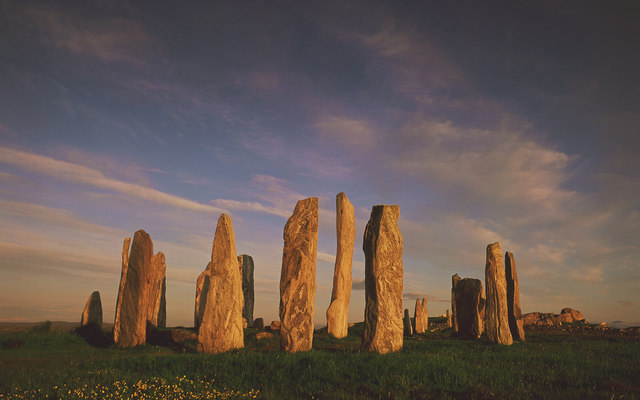
A celestial clockwork
The Callanish Stones (Calanais I) function as a massive astronomical instrument. The site's primary layout is a circle of 13 stones surrounding a large central monolith, with an avenue and shorter stone rows extending outwards. This arrangement aligns with a rare celestial event: the major lunar standstill. This phenomenon happens on an 18.6-year cycle, which is the time it takes for the plane of the Moon's orbit to precess, or wobble, through one full rotation.
During a major standstill, the Moon's monthly path across the sky reaches its maximum and minimum extremes. From the specific viewpoint of the Callanish Stones, the full moon closest to the summer solstice appears to skim along the southern horizon. The distant hills form a silhouette of a reclining woman, known locally as "Cailleach na Mointeach" or "The Old Woman of the Moors." The moon appears to travel along this ridge before setting among the stones, an event that the site’s builders oriented the main avenue to frame. The next major lunar standstill will peak in 2025.
Neolithic engineering
Construction of the stone circle began between 2900 and 2600 BCE, making it older than Stonehenge's main sarsen circle. The monument was built in phases. The central circle, with its 13 stones and 4.8-meter-high central monolith, was erected first. Around 400 to 500 years later, the avenue and stone rows were added, shifting the site from a possible solar alignment to the lunar standstill. A small chambered tomb was also inserted into the circle after the initial construction.
The stones themselves are Lewisian gneiss, a metamorphic rock between 1.7 and 3 billion years old, making it some of the oldest rock in Britain. The entire complex includes a central circle approximately 13 meters in diameter, a northern avenue of stones 83 meters long, and three shorter rows to the south, east, and west, forming a cross shape. The site is part of a larger ritual area, with at least 15 other smaller stone circles and megalithic sites located within a few kilometers. For centuries, the lower portions of the stones were buried under nearly two meters of peat, which was cleared in 1857, revealing their true height.