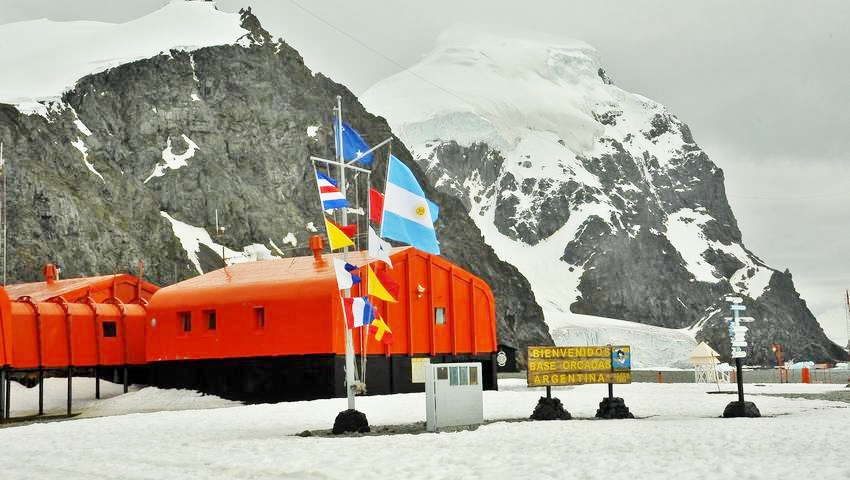
The oldest outpost in Antarctica
On Laurie Island, part of the remote South Orkney Islands, sits Orcadas Base, the oldest continuously inhabited facility in all of Antarctica. Its history began in 1903, when the Scottish National Antarctic Expedition, led by William Speirs Bruce, constructed a stone hut called Omond House to be a meteorological station. Unable to maintain the outpost, Bruce transferred it to Argentina, and on February 22, 1904, the Argentine flag was raised for the first time. This date marks the beginning of Argentina's permanent presence on the continent, a presence that has now lasted for more than 120 years without interruption.
This continuous occupation is the basis of Argentina's territorial claim to a wedge of the continent known as Argentine Antarctica. The claim, formalized by decrees in the 1940s, extends from the 25°W to the 74°W meridian, south of the 60°S parallel. While the 1959 Antarctic Treaty holds all territorial claims in abeyance to promote scientific cooperation, the long-standing operation of Orcadas and other bases represents a significant part of Argentina's national identity. The mapping of this claimed sector has been an ongoing effort, with a 2020 law updating the official map of Argentina to include the Antarctic Peninsula, reinforcing its status as a "bicontinental" nation.