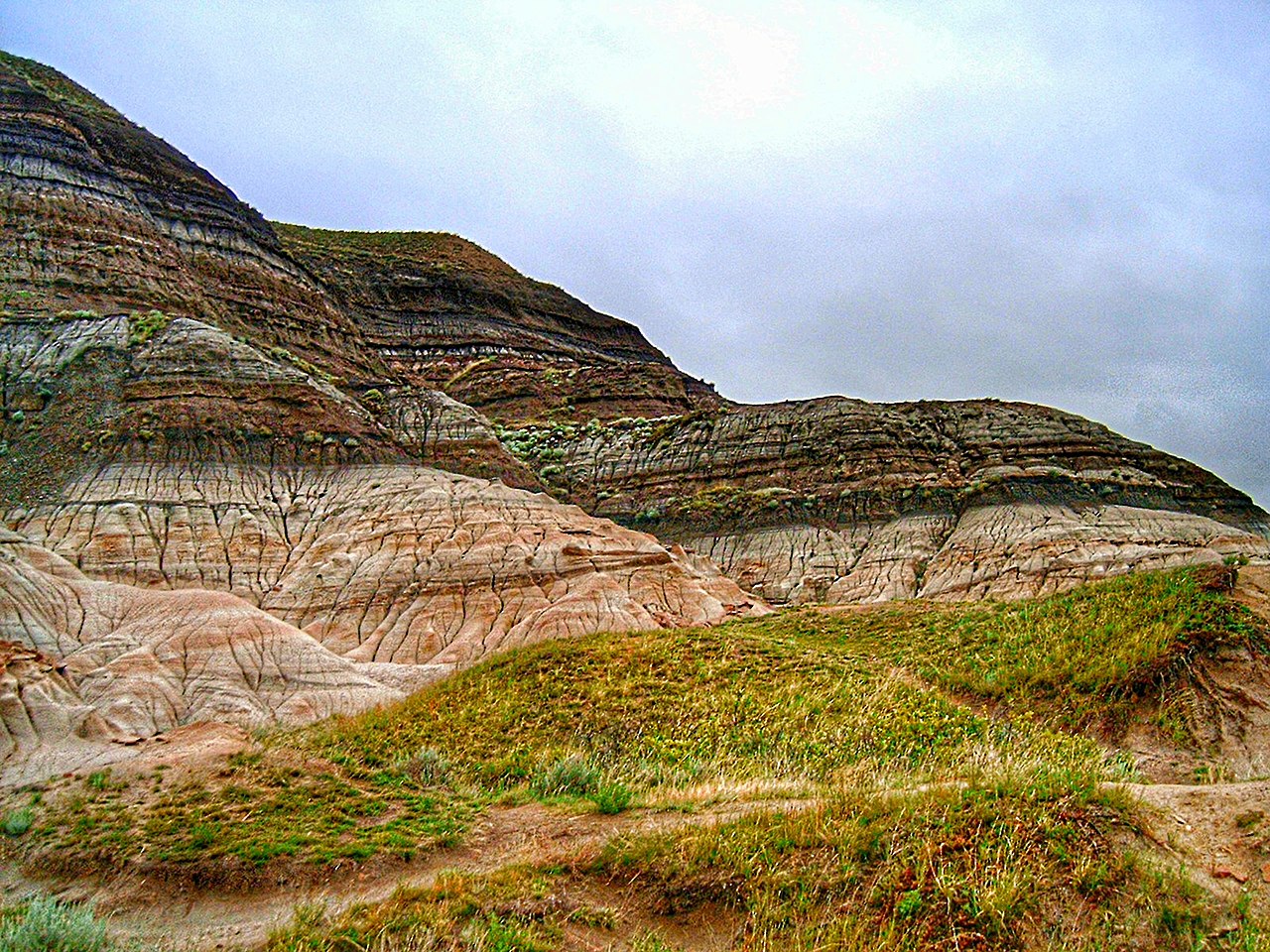
The closest accessible land outcrop of debris blasted out when the dinosaur-killing asteroid struck 66 million years ago. The rocks here contain shocked quartz, tektites, and spherules that rained down in the hours after impact. You can literally hold pieces of the apocalypse in your hands.
Original uploader was Glenlarson at en.wikipedia, Public domain, via Wikimedia Commons
The day the world changed
About 66 million years ago, an asteroid between 10 and 15 kilometers wide struck the Earth. The impact, centered on the Yucatán Peninsula, released energy equivalent to billions of atomic bombs and triggered the Cretaceous-Paleogene extinction event, which eliminated about 75% of all species, including the non-avian dinosaurs. Albion Island, located in a quarry about 365 kilometers from the crater's center, is the closest surface exposure of the material ejected by this cataclysm.
The geological record of this event is known as the K-Pg boundary. At Albion Island, this boundary is preserved as a distinct sequence called the Albion Formation. This formation is composed of two main layers. The lower layer, called the "spheroid bed," is about one meter thick. It sits directly on top of the Late Cretaceous dolomite that formed the shallow sea floor just before the impact. Above this is a much thicker layer, up to 15 meters, of a chaotic rock mixture known as diamictite. This entire 16-meter sequence is one of the thickest known outcropping K-Pg boundary sections in the world. The material hurtled from the crater and was deposited here within minutes to hours of the impact.
A catalog of cosmic debris
The layers at Albion Island contain a variety of impact-related materials. The basal spheroid bed is packed with small, bead-like structures. Many of these are spherules, ranging from 1 to 20 millimeters in diameter, formed from molten rock that was blasted into the atmosphere, solidified into glass, and rained down. While true tektites are rare, the rocks contain altered impact glass and unique dolomite spheroids, which may be the equivalent of tektites formed from vaporized carbonate target rock.
The most definitive evidence of a hyper-velocity impact found here is shocked quartz. These quartz grains, when viewed under a microscope, show parallel deformation features that can only be created by the immense, instantaneous pressure of an asteroid strike. The diamictite layer above contains a mix of these materials and massive boulders, some as large as 8 meters in diameter, ripped from the surrounding landscape and thrown here by the blast. The presence of a slight iridium anomaly, a common feature of the K-Pg boundary worldwide, has also been detected in the spheroid bed. This iridium is rare in Earth's crust but more common in asteroids, identifying the impactor.
💡Fun Facts
The Albion Island site was a shallow marine environment that was exposed to the air when the impact occurred.
Some rocks in the diamictite layer show striations and polished surfaces, evidence of the violent, abrasive flow of debris away from the crater.
The impact ejecta at Albion Island is sometimes called the "Albion Formation" by geologists.
The energy from the Chicxulub impact vaporized over 600 cubic kilometers of sedimentary rock from the Yucatán platform.
The site is an active quarry (Albion Stone Company Quarry). Access is not guaranteed and may require permission from the quarry operators. It is not a formal tourist park.
Admission
N/A; access is subject to permission from the private quarry operator.
Accessibility
As an active quarry, the terrain is uneven, rocky, and potentially hazardous. It is not suitable for individuals with mobility challenges.