A forest carved from an ancient seabed
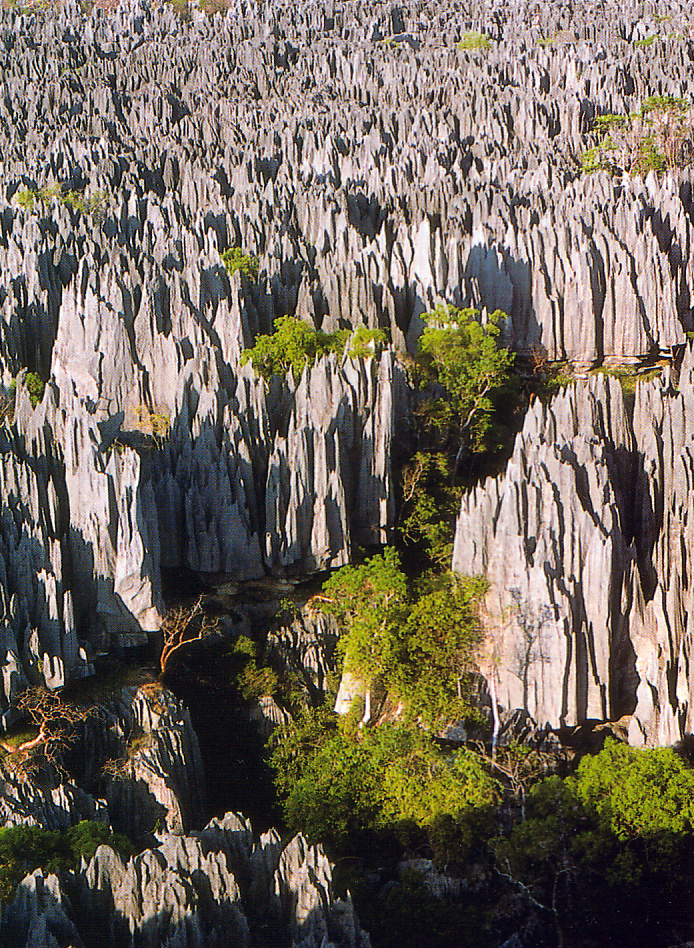
The Tsingy de Bemaraha is a limestone plateau sculpted over millions of years into a dense forest of sharp rock pinnacles. The process began during the Jurassic period, around 200 million years ago, when the area was a shallow sea. Layers of coral and seashell remains compacted on the seabed, forming a thick limestone bed. Tectonic activity later uplifted this plateau, exposing it to the elements.
For millennia, heavy monsoon rains, which are slightly acidic, have dissolved the limestone. This chemical weathering, a process known as karstification, has etched deep vertical fissures and horizontal caverns into the rock. The result is a terrain of razor-sharp spires, some reaching up to 100 meters in height, separated by deep canyons. The Malagasy word "tsingy" translates to "where one cannot walk barefoot," an accurate description of the treacherous terrain. This entire protected area, a UNESCO World Heritage site since 1990, spans over 1,500 square kilometers.
Laboratories of evolution
The extreme topography creates a mosaic of micro-habitats, turning the stone forest into a biological hotspot. The summit, slope, and base of a single limestone needle can host different ecosystems, with different species clinging to the steep surfaces. This fragmentation isolates populations of plants and animals, preventing them from interbreeding and accelerating the process of speciation.
The park contains many endemic species. Of the fauna and flora found here, about 85% are endemic to Madagascar, with many found only within the confines of Bemaraha itself. This includes 11 species of lemur, such as the all-white Decken's sifaka (Propithecus deckenii), and the locally endemic Bemaraha woolly lemur (Avahi cleesei). The Antsingy leaf chameleon (Brookesia perarmata) is another species found only in this park. The impassable terrain also protects over 650 plant species, protecting them from human activity. The deep canyons contain dense, humid forests, while the exposed peaks support xerophytic plants adapted to dry conditions. Researchers continue to discover new species of frogs, bats, and reptiles in this largely unexplored environment.