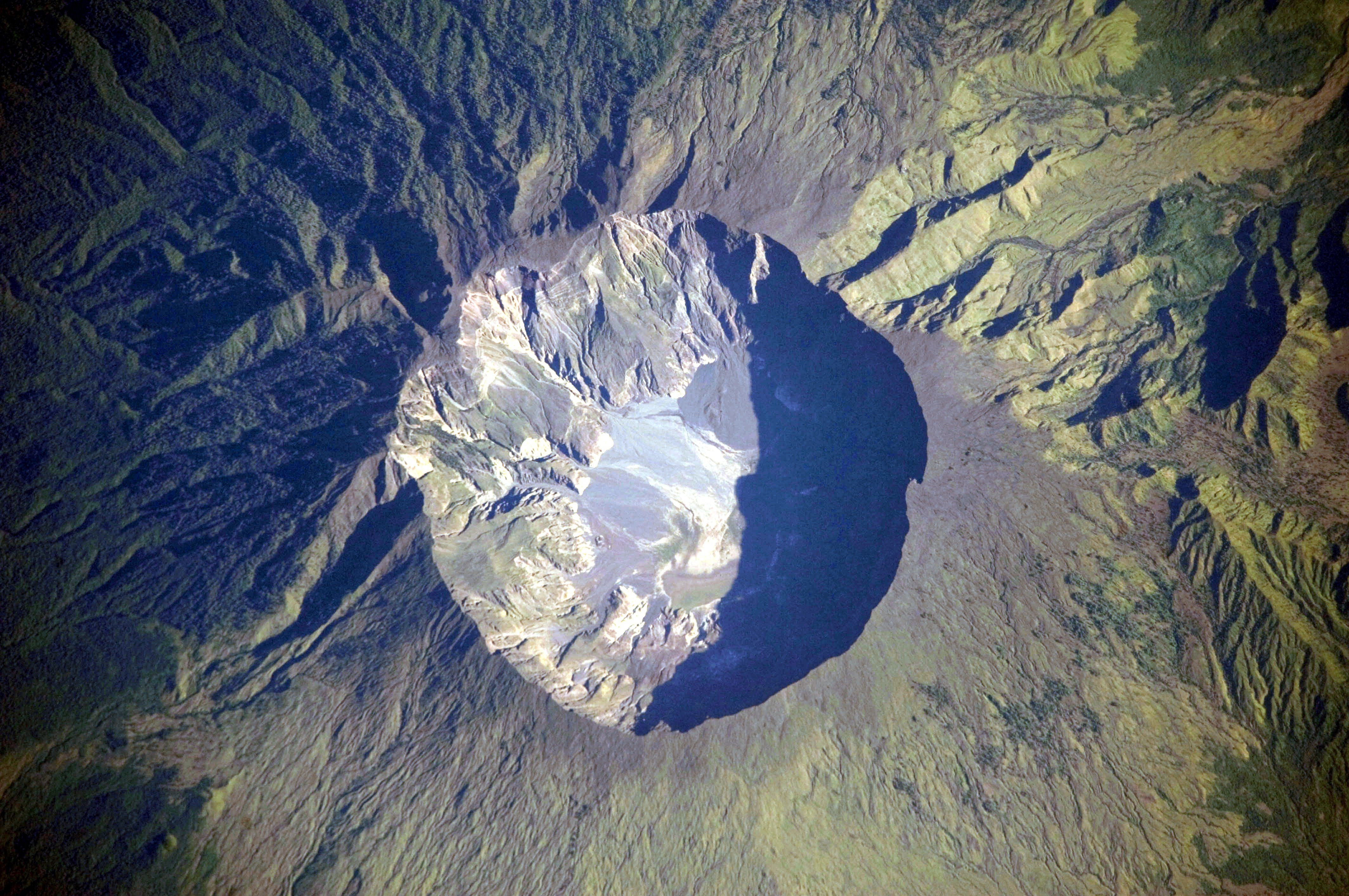
Massive eruptions inject sulfur dioxide into the stratosphere, creating reflective aerosols that cool the planet for years. Tambora 1815 caused the "Year Without a Summer." The exact atmospheric chemistry determining how long volcanic winters last is still being refined.
This image was taken by the NASA Expedition 20 crew., Public domain
The Tambora precedent
In April 1815, Mount Tambora on the Indonesian island of Sumbawa produced the largest volcanic eruption in recorded history. The event registered a 7 on the Volcanic Explosivity Index (VEI), ejecting an estimated 100 cubic kilometers of pulverized rock, ash, and gas into the atmosphere. The eruption column reached more than 45 kilometers (148,000 feet), punching deep into the stratosphere. While the immediate blast and subsequent pyroclastic flows and tsunamis killed tens of thousands, the eruption's most far-reaching impact came from one chemical: sulfur dioxide (SO2).
The massive injection of sulfur compounds into the stratosphere led to a global climate anomaly. The year 1816 was the "Year Without a Summer" in the Northern Hemisphere. Average global temperatures dropped by 0.4–0.7°C (0.7–1°F), with some regional extremes being much greater. In New England, killing frosts occurred in June, July, and August. Snow fell in Albany, New York, and parts of Maine in June. Europe, still recovering from the Napoleonic Wars, was plunged into a severe food crisis as crops failed due to the cold and incessant rains. The resulting famine and outbreaks of diseases like typhus led to widespread hardship and civil unrest. The climate disruption and its effects persisted for approximately three years before the atmosphere began to return to normal.
A veil of stratospheric acid
The duration and intensity of a volcanic winter depend less on the volume of ash and more on the mass of sulfur dioxide injected into the stratosphere. Above the troposphere—the atmospheric layer where weather occurs—there is no rain to wash particles out. Here, SO2 gas reacts with water vapor to form tiny droplets, or aerosols, of sulfuric acid (H2SO4). These aerosols, with an effective radius of about 0.5 micrometers, are highly effective at scattering incoming solar radiation back into space. This increases the Earth's albedo, or reflectivity, cooling the surface below.
The 1991 eruption of Mount Pinatubo in the Philippines provided a modern, well-documented example of this process. It was the second-largest eruption of the 20th century and injected about 17 million metric tons of SO2 into the stratosphere. This resulted in a global temperature drop of about 0.4°C (0.7°F) that lasted for about two to three years.
Several factors determine how long these aerosols persist. The altitude of the injection is important; higher injections mean a longer residence time for the aerosols. The latitude of the volcano also matters. Tropical eruptions, like Tambora and Pinatubo, are more effective at creating a global cooling effect because the stratospheric circulation patterns efficiently distribute the aerosols across both hemispheres. The exact size of the formed aerosol particles also plays a role; larger particles fall out of the atmosphere faster, while smaller ones can remain suspended for several years, prolonging the cooling effect.
💡Fun Facts
The gloomy, rain-soaked summer of 1816 confined Mary Shelley and her companions indoors near Lake Geneva, where they held a ghost story competition that led to her writing *Frankenstein*.
Widespread crop failures following the Tambora eruption made oats prohibitively expensive to feed horses, which may have motivated German inventor Karl Drais to create the "Laufmaschine," an early precursor to the modern bicycle.
The spectacular sunsets with bright red and yellow hues, caused by Tambora's stratospheric aerosols scattering sunlight, are thought to have inspired the dramatic skies in the paintings of British artist J.M.W. Turner.
The Toba supereruption in Indonesia around 74,000 years ago was thousands of times larger than Tambora and may have triggered a volcanic winter lasting six to ten years.
Mount Tambora National Park is generally open for trekking during the dry season, from approximately May to October. The park is often closed during the rainy season (December to April) due to hazardous conditions.
Admission
Entrance fees are required for the national park. It is mandatory to hire local guides for navigation and safety.
Accessibility
The trek to the crater rim is physically demanding, involving steep, rugged terrain over a multi-day hike. It is not accessible for individuals with mobility issues. Some routes allow for 4WD vehicle access part of the way.