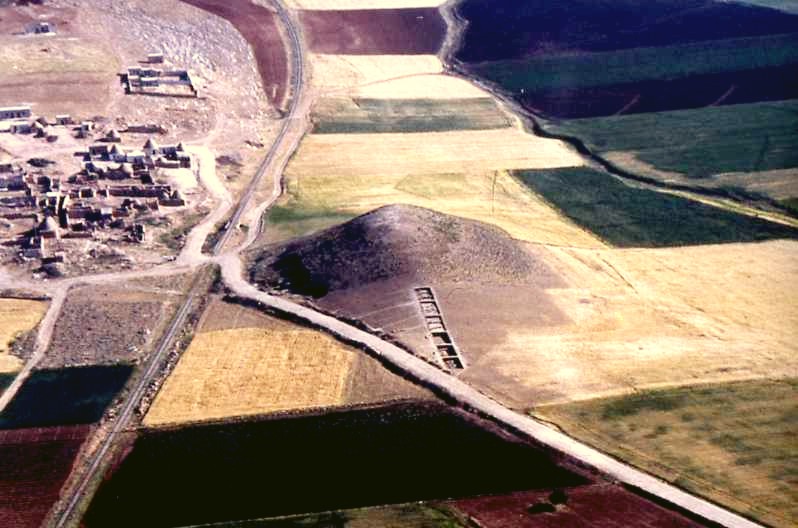
A settlement before agriculture
Located 25 kilometers north of Aleppo, the archaeological mound of Tell Qaramel upends traditional timelines of civilization. Excavations by a joint Polish-Syrian team, which began in 1999, revealed a settlement from the Pre-Pottery Neolithic A (PPNA) period. This phase marks the very beginning of settled life, before the widespread invention of pottery or the domestication of plants and animals. Radiocarbon dating of charcoal samples places the earliest occupation of Tell Qaramel between 10,900 and 9,650 BC. This makes the structures at Tell Qaramel older than the famous tower at Jericho, previously thought to be the world's first.
The site's most significant features are five successive circular stone towers, built over centuries. The most massive of these measures 7.5 meters in diameter with stone walls 2.25 meters thick. These were not simple huts; they were substantial public works. The discovery of such monumental architecture created by a society of hunter-gatherers is unexpected. It demonstrates that complex social organization and large-scale construction projects existed long before the advent of agriculture, which was previously believed to be a prerequisite for such developments. The people of Tell Qaramel lived in a permanent village of semi-subterranean round or oval houses, hunting wild animals and gathering wild plants for sustenance.
Life and ritual at the dawn of the Neolithic
The inhabitants of Tell Qaramel left behind a detailed record of their culture. Archaeologists have unearthed numerous artifacts, including finely crafted stone objects. These include decorated limestone and chlorite vessels and stone tools like pestles, grinders, and axes. Ornaments and figurines of humans and animals carved from stone show their symbolic world. The discovery of obsidian tools, with the raw material sourced from Anatolia, shows long-distance trade networks.
Burial practices at Tell Qaramel point to complex rituals for death. Excavations have uncovered 23 graves containing the remains of 34 adults. A common practice was the removal of the skull after death, a custom also seen at other PPNA sites like Jericho. This suggests a form of ancestor veneration or a "cult of the head." Other ritual evidence includes a pit containing four skulls of wild bulls, showing beliefs that would become more common later in the Neolithic period. The purpose of the towers themselves is a subject of scientific debate. Their robust construction suggests a defensive role, yet interior features like benches and hearths point toward a communal or ceremonial function. Some show signs of being burned and rebuilt, adding another layer to their long history.