An Oceanic Amplifier
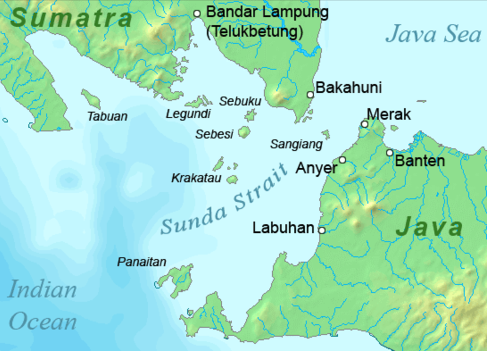
The Sunda Strait, a waterway separating the Indonesian islands of Java and Sumatra, acts as a remarkable natural amplifier for the ocean's tides. This channel, connecting the expansive Indian Ocean to the Java Sea, has a specific combination of length and depth that creates a powerful tidal resonance. The phenomenon is most pronounced with the semidiurnal tide—the twice-daily rise and fall of the sea. As the tidal wave from the Indian Ocean enters the strait, its frequency closely matches the strait's own natural frequency of oscillation. This alignment causes the water to slosh back and forth with increasing amplitude, much like rhythmically pushing a child on a swing to go higher.
The physical dimensions of the strait are fundamental to this effect. At its narrowest point, it is only 24 kilometers (15 miles) wide. The depth is also highly variable, becoming much shallower at its northeastern end, with a minimum depth of only 20 meters (66 feet) in some areas. This specific bathymetry forces the enormous volume of water into a constricted channel, led to for the resonance that dramatically alters the tidal behavior within the strait.
The Physics of a Resonating Strait
The tidal amplification in the Sunda Strait is Helmholtz resonance, a concept often used to describe how air resonates in a cavity, like when one blows across the top of a bottle. In this oceanographic version, the Java Sea acts as the large cavity, and the Sunda Strait is the narrow neck. Water flowing in from the Indian Ocean oscillates in the "neck" at a frequency that excites the water in the "cavity," leading to a significant increase in the tidal range.
This resonance doubles the height of the tides compared to what they would be otherwise. While typical tidal ranges in the area are around one meter, the resonance amplifies them significantly. The effect also generates exceptionally strong tidal currents. These currents consistently reach speeds of 2 to 3 meters per second (about 6.6 to 9.8 feet per second) and can even exceed 5 m/s during peak periods. The flow is not simple; it creates a complex environment of whirlpools and eddies that make navigation notoriously difficult. The constant and powerful flow of water through this channel is part of the Indonesian Throughflow, a system of currents that moves water from the Pacific to the Indian Ocean and influences global ocean circulation and climate patterns.
Tapping the Tidal Power
The immense and predictable power of the Sunda Strait's currents has made it a focus for renewable energy research. Studies estimate that the total extractable power from the strait's tidal stream could be around 300 to 335 megawatts (MW). This potential is significant for Indonesia, a populous island nation seeking sustainable energy sources.
Engineers are assessing the feasibility of deploying arrays of underwater turbines, similar to wind turbines, to capture this kinetic energy. These devices would be placed in the fastest-flowing sections of the strait to convert the tidal movement into electricity. However, the plan faces several challenges. The strait is an important and busy shipping lane, and any energy infrastructure must not interfere with maritime traffic. The complex seabed, strong currents, and potential for volcanic and seismic activity from nearby Krakatoa add to the engineering difficulties. Despite these obstacles, the Sunda Strait is one of Indonesia's most promising locations for generating clean, reliable tidal power.