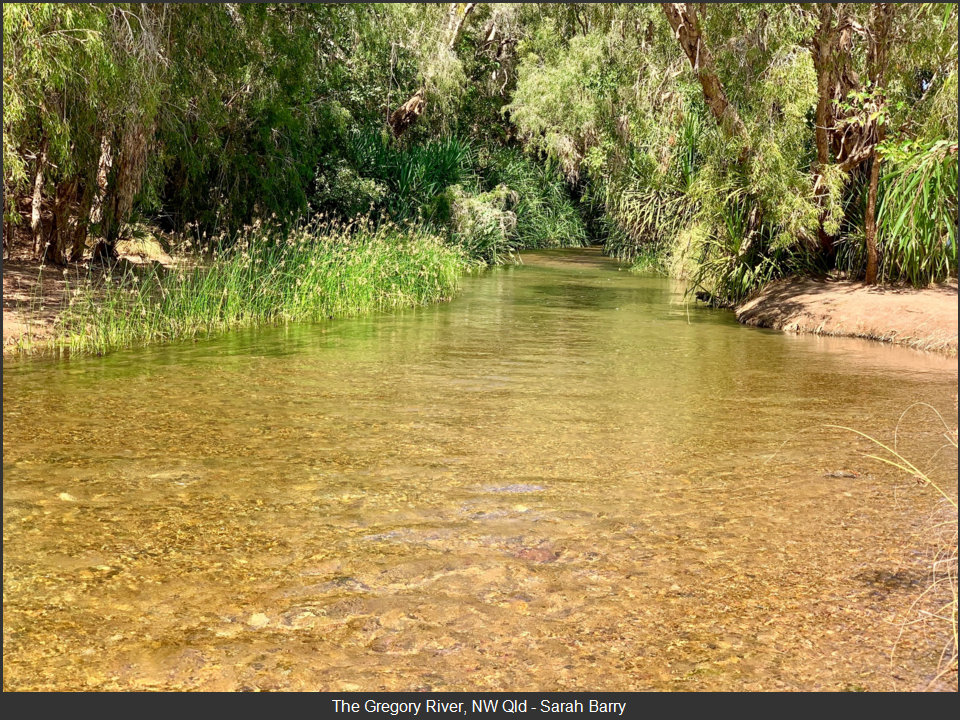
A river that builds itself
The Gregory River in remote northwestern Queensland is a geological anomaly. In a largely dry, savanna landscape, this river flows all year, building its own limestone dams as it goes. These structures, known as tufa cascades, form because the river's water is supersaturated with calcium carbonate. This mineral-rich water originates from springs that emerge from ancient, soluble limestone and dolomite formations, including the Cambrian-era Thorntonia Limestone.
As this groundwater reaches the surface and becomes a river, the chemistry and physics of the water change. The turbulence created as water flows over rocks and existing dams causes carbon dioxide to release from the water into the atmosphere. This process, called CO2 outgassing, along with high rates of evaporation in the tropical heat, makes the calcium carbonate less soluble, causing it to precipitate out of solution. The result is the deposition of tufa, a porous and brittle form of limestone, which slowly but constantly builds the cascade structures. This process occurs so rapidly that submerged objects can become completely coated in a layer of new rock within weeks.
A biologically mediated landscape
The formation of the Gregory River's tufa dams is not a purely chemical process; it is heavily influenced by life. The surfaces of the submerged rocks and dams are coated in biofilms of microorganisms, particularly cyanobacteria. Through photosynthesis, these microbes remove dissolved carbon dioxide from their immediate surroundings, further encouraging calcium carbonate to precipitate. The sticky, mucilaginous secretions of these bacteria also help trap fine particles of calcite, binding them to the dam structure.
Aquatic insect larvae also help build the structures. Caddisfly, midge, and moth larvae build protective casings for themselves using available materials, and in the Gregory River, this includes precipitated calcite particles. Over time, these larval structures become incorporated into the growing tufa, adding to its mass and porous texture. The resulting dams create a series of stepped pools, altering the river's flow and creating unique aquatic habitats that support an ecosystem, including water lilies, pandanus, ghost gums, and numerous fish. The tufa formations themselves are often contain the fossilized remains of gastropods (snails) and other molluscs.