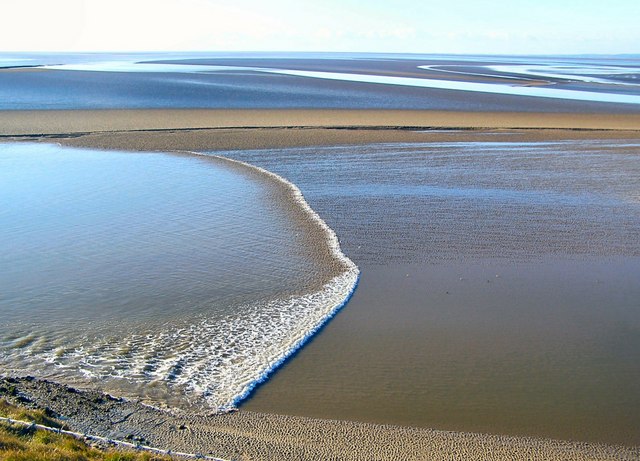
A Wave That Flows Backwards
The Mascaret is a tidal bore, a rare natural event that occurs in only about 60 estuaries worldwide. It manifests as a wave, or series of waves, that travels upriver against the natural current. This phenomenon is a product of specific hydrographic and astronomical conditions. The Gironde estuary, where the Garonne and Dordogne rivers meet the Atlantic, provides the ideal setting. It is a long, funnel-shaped macrotidal estuary where the tidal range can exceed 5 meters.
The process begins far out in the Atlantic. The incoming high tide is forced into the constricting and shallowing channel of the estuary. This compression causes the front of the advancing tide to steepen, eventually forming a breaking wave. The wave's power is greatest when the tidal coefficient—measuring the tidal range—is high, typically above 90. This occurs most frequently between June and October, with the most dramatic bores often appearing around the spring and autumn equinoxes. Low river discharge also contributes to a stronger wave, as there is less opposing current for the tide to overcome. The resulting wave travels at speeds between 15 and 30 km/h, temporarily reversing the river's flow.
Surfing the River
The Mascaret is not a single event but occurs twice daily with every rising tide. However, only about fifty of these are considered remarkable each year. The most famous viewing and surfing spot is the port of Saint-Pardon in the commune of Vayres, where a nearly 5-kilometer straight stretch of river allows the wave to build and maintain its form. Spectators and surfers gather here, listening for the characteristic low rumble that announces the wave's imminent arrival.
Dozens of surfers, kayakers, and paddleboarders often ride the same wave simultaneously. The wave itself can be an undular bore, which is a smooth wave followed by a train of smaller waves called whelps, or a breaking bore, depending on the river's depth and the tide's strength. The longest rides can last for more than ten minutes, covering significant distances upstream. Historically, the Mascaret was a known hazard, capable of capsizing ships. Today, it is primarily a natural spectacle. The bore has a significant impact on the river's morphology by churning up and transporting large quantities of sediment upstream, a process that visibly increases the water's turbidity.