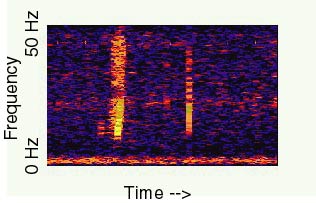
The loudest underwater sound ever recorded in 1997 came from here. Eventually attributed to icequakes, but the frequency profile matched no known cryogenic process at the time.
National Oceanic and Atmospheric Administration, Public domain, via Wikimedia Commons
A Sound Across the Ocean
In the summer of 1997, hydrophones searching for underwater volcanoes recorded an astonishingly loud, ultra-low-frequency sound. The U.S. National Oceanic and Atmospheric Administration (NOAA) named it "The Bloop." It was detected by the Equatorial Pacific Ocean autonomous hydrophone array, a network of underwater microphones originally built to listen for Soviet submarines during the Cold War. The sound was so powerful it was registered on multiple sensors across the Pacific Ocean, some over 5,000 kilometers (3,100 miles) apart.
The signal lasted for approximately one minute, during which its frequency rose rapidly. This acoustic signature resembled calls made by marine animals. However, the sheer volume of the Bloop was baffling. No known animal, including the blue whale, whose calls are among the loudest in the animal kingdom, could generate a sound powerful enough to travel across the entire Pacific basin. Scientists calculated that the source would have to be several times louder than any biological sound ever recorded. This discrepancy fueled years of speculation about a colossal, undiscovered sea creature lurking in the ocean's unmapped depths.
From Sea Monster to Icequake
The mystery of the Bloop persisted for years. Its origin was triangulated to a remote area of the southern Pacific Ocean, west of the southern tip of South America. This location, coincidentally near the coordinates for the fictional sunken city of R'lyeh in H.P. Lovecraft's short story "The Call of Cthulhu," added to the popular myth surrounding the sound. While NOAA scientists ruled out human-made sources like military exercises, the sound's true nature remained elusive.
The answer began to emerge as NOAA deployed more hydrophones closer to Antarctica. In 2005, researchers started recording similar powerful, low-frequency sounds. By tracking the disintegration of a massive iceberg known as A53a near South Georgia Island in 2008, they found a match. The sounds generated by the iceberg as it cracked and fractured—a phenomenon called a cryoseism or "icequake"—produced spectrograms remarkably similar to the Bloop. The conclusion, announced by NOAA around 2012, was that the 1997 Bloop was the sound of ice, not a monster; the sound of a massive iceberg breaking apart in Antarctica. The sound was likely generated somewhere between the Bransfield Strait and the Ross Sea.
💡Fun Facts
The hydrophone array that detected the Bloop was an evolution of the U.S. Navy's Sound Surveillance System (SOSUS), created during the Cold War to track Soviet submarines.
The coordinates for the Bloop's origin are near the location H.P. Lovecraft chose for the sunken city of R'lyeh, where the fictional creature Cthulhu lives.
The original recording of the Bloop is typically sped up 16 times to make its low frequency audible to the human ear; at its real speed, it sounds more like distant thunder.
Other mysterious underwater sounds recorded by NOAA, such as "Julia," "Train," and "Slow Down," are now also largely attributed to ice-related events.