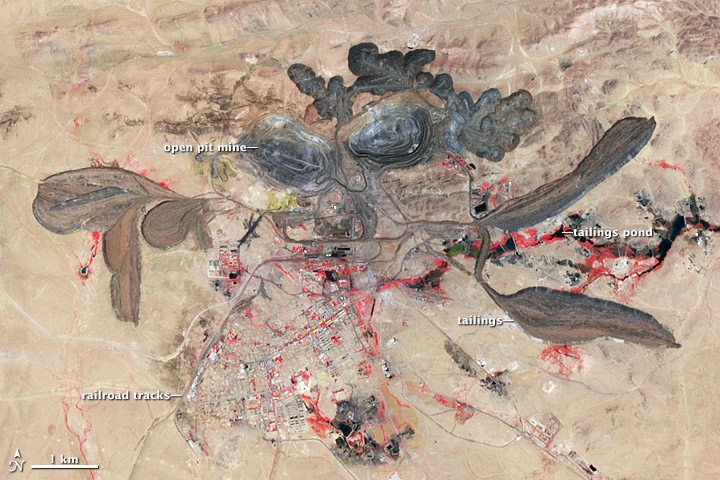
The largest deposit of rare earth elements on Earth, located in Inner Mongolia. These metals are essential for smartphones, electric vehicles, and wind turbines. Despite decades of mining, geologists still argue about how such a massive concentration formed.
NASA Earth Observatory, Public domain, via Wikimedia Commons
A geological phenomenon
The Bayan Obo deposit is an immense concentration of valuable industrial metals. The site holds an estimated 48 to 100 million metric tons of rare earth element (REE) ore, primarily in the form of the minerals bastnäsite and monazite. It is also one of the world's largest iron deposits, with reserves of 1.5 billion metric tons of iron ore, mainly magnetite and hematite. On top of this, it contains about one million metric tons of niobium ore. The mineralogy is exceptionally complex; geologists have identified over 170 different minerals containing 71 chemical elements within the ore bodies.
The main ore is located within a specific geological formation from the Proterozoic eon, a dolomite marble unit designated H8. This rock layer sits within the larger Bayan Obo Group, a sequence of ancient sedimentary rocks. The deposit itself is a massive lens-shaped body stretching for 18 kilometers from east to west. Analysis of the ore shows it is predominantly rich in light rare earth elements (LREEs) like cerium, lanthanum, and neodymium, but it also contains considerable amounts of medium and heavy rare earths.
The billion-year debate
The origin of the Bayan Obo deposit is a long-standing geological question. For decades, two main theories competed for acceptance. One proposed that the H8 host rock was a sedimentary limestone, deposited on an ancient sea floor, which was later infiltrated and replaced by hot, metal-bearing hydrothermal fluids. The opposing theory argued that the H8 dolomite is actually a carbonatite, a rare type of igneous rock that originates from the Earth's mantle. In this case, the carbonatite magma would have brought the immense metal endowment with it from deep within the planet.
Years of research now point to a hybrid, multi-stage process of formation that is far more complex than either single theory. Radiometric dating of minerals from the deposit yields a bafflingly wide range of ages. Some data suggests an initial mineralizing event linked to carbonatite intrusion around 1.3 billion years ago. However, there is strong evidence for a second, major period of ore concentration and modification that happened much later, between 420 and 450 million years ago. This later event is associated with the Caledonian orogeny, a period of mountain-building that deformed the rock and drove new hydrothermal fluids through the deposit. This complex history, with multiple events separated by hundreds of millions of years, is why the deposit's formation is debated by scientists.
💡Fun Facts
When discovered by the geologist Ding Daoheng in 1927, it was identified as an iron deposit; its true value as a source of rare earths was not immediately understood.
The mineralogy is so diverse that over 170 distinct mineral types have been identified at the site.
The ore contains naturally occurring radioactive elements, particularly thorium, which concentrates in the waste material after processing.
The scientific debate about its origin is fueled by radiometric dates that show mineralization occurred in separate episodes nearly one billion years apart.