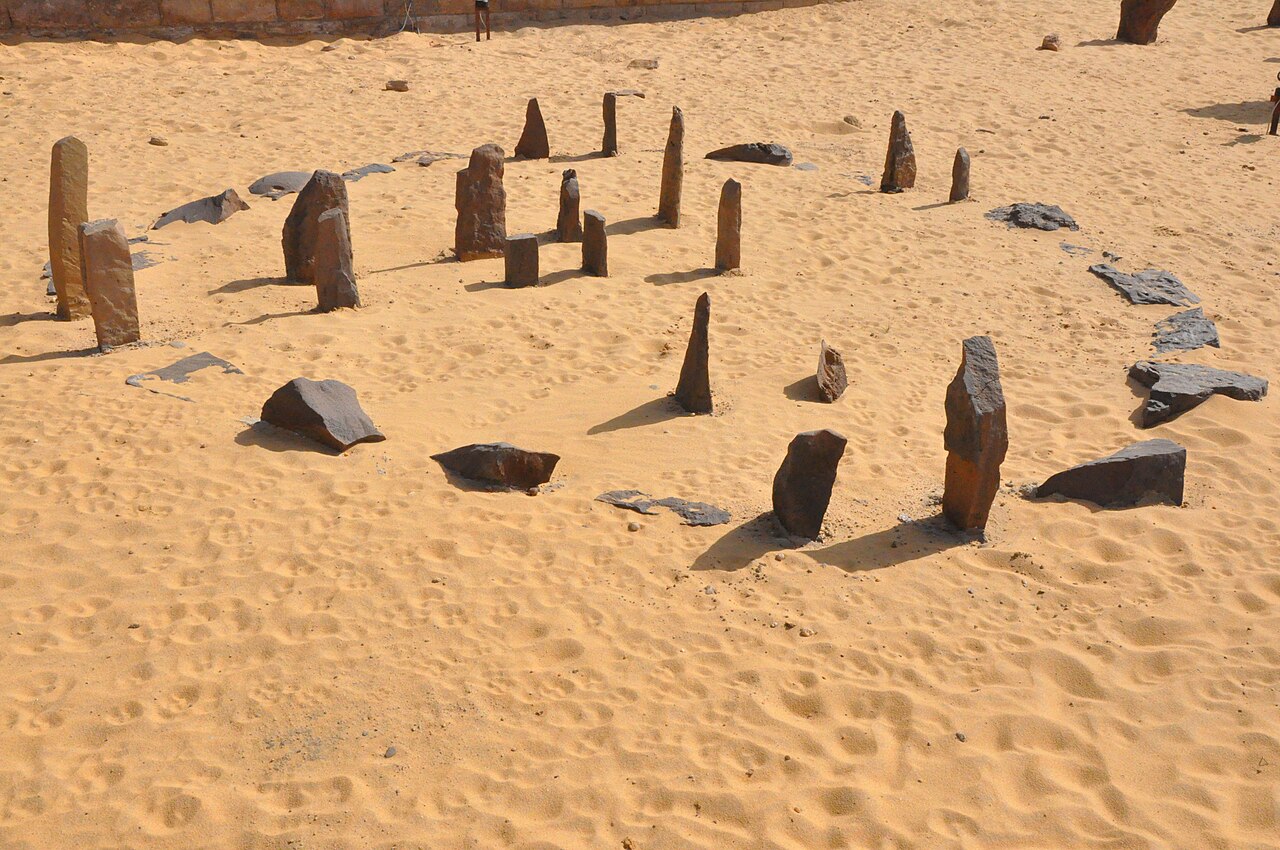
Monuments of a Lost World
In the hyper-arid landscape of Egypt's Western Desert, hundreds of kilometers from the Nile, stand the remnants of an earlier era. The Bashendi B megaliths are collections of standing stones, stone circles, and slab-lined chambers left by a Neolithic society that flourished here when the Sahara was a wet, grassy savanna. This period, known as the African Humid Period, lasted from approximately 14,500 to 5,000 years ago, transforming the desert into an area of lakes and grasslands capable of supporting large animals and human communities.
The people who built these monuments belonged to the Bashendi B cultural unit, which existed in the Dakhla Oasis region from about 5400 BCE to 3800 BCE. These were mobile pastoralist groups who herded cattle and goats while also hunting local wildlife. Their archaeological sites are not large settlements but open-air camps, identified by clusters of hearth mounds, stone tools, and pottery. Unlike the earlier Bashendi A culture, which built multi-room slab structures, the Bashendi B people left behind more ephemeral signs of their presence, except for these enduring stone monuments. The stones themselves are typically local sandstone, shaped into rough slabs and erected for purposes that were ceremonial and likely astronomical.
Desert Skywatchers
The function of the Bashendi B megaliths is tied to the beliefs and practical needs of these ancient pastoralists. Like the more famous Nabta Playa site 700 miles to the south, these structures are considered early examples of archaeoastronomy. Researchers suggest the stone alignments correspond to the rising and setting of significant stars or constellations, as well as the summer solstice. For a society dependent on seasonal rains for the survival of their herds, a calendar of this nature would have been essential for predicting the arrival of the monsoon.
Excavations around these megalithic sites reveal a complex ritual life. Hearths filled with fire-cracked rock are common, some nearly half a meter high and capped with sandstone slabs. Pits containing the remains of both juvenile and mature cattle, some with bones cracked open for marrow, point to ritual feasts or sacrifices. The presence of cattle in ceremonial contexts is a recurring feature in Saharan Neolithic cultures, suggesting a deep cultural importance beyond their use as livestock. The social organization required to quarry, transport, and erect these multi-ton slabs also shows a society with a degree of complexity and shared purpose, challenging older ideas of prehistoric desert dwellers as simple, scattered groups.