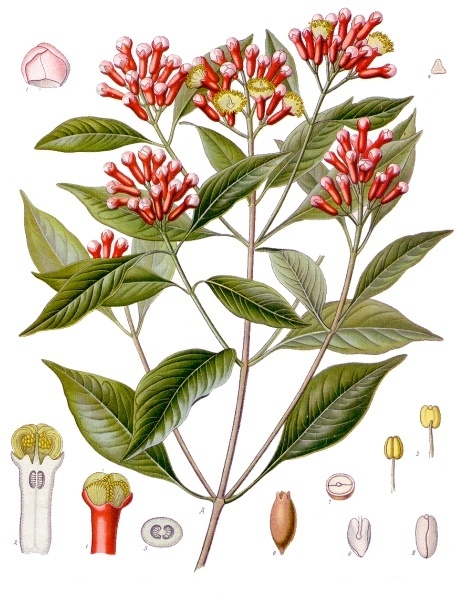
Every clove in your kitchen cabinet is a descendant of trees once found only on this tiny Indonesian island.
Franz Eugen Köhler, Köhler's Medizinal-Pflanzen, Public domain, via Wikimedia Commons
The world's only source of cloves
Until the 18th century, the clove tree, Syzygium aromaticum, grew exclusively on Ternate, Tidore, and a few other volcanic islands in the North Maluku province of Indonesia. The combination of volcanic soil and a tropical marine climate created the perfect environment for this one plant. The spice we call a clove is the tree's unopened flower bud. These buds contain a high concentration of the aromatic chemical compound eugenol, which makes up 80-90% of clove essential oil. This compound gives the spice its intense, pungent flavor and aroma.
Archaeological evidence shows that cloves were traded out of the Maluku Islands as early as 1720 BC, with specimens found by archaeologists in Syria. By 200 BCE, envoys to the Han Dynasty court in China were required to chew cloves to sweeten their breath before speaking to the emperor. For centuries, the source of this valuable spice was a closely guarded secret, controlled by local sultanates and a complex network of traders. The Sultanate of Ternate, in particular, grew incredibly wealthy and powerful from exclusive control over the world's clove supply.
A monopoly broken by a single tree
When Europeans arrived in the early 16th century, they fought for control of the lucrative spice trade. First the Portuguese, then the Spanish, and finally the Dutch sought to dominate the market. In 1607, the Dutch East India Company (VOC) established Fort Oranje on Ternate, which was its headquarters until 1619. The VOC enforced a brutal monopoly. To keep prices artificially high, they restricted cultivation and engaged in "extirpation"—the destruction of any clove trees not under their direct control. Anyone caught growing, possessing, or smuggling clove plants faced the death penalty. The company would burn or dump any harvest that exceeded their annual export limit of 800-1000 tons.
This monopoly was finally broken in 1770 by a French missionary and horticulturalist named Pierre Poivre. Poivre managed to smuggle seedlings from a single surviving tree, known as Afo, hidden on the slopes of Ternate's Gamalama volcano. He successfully transported the seedlings to the French colonies of Mauritius and Réunion. From there, clove cultivation spread to other parts of the world, including Zanzibar and Madagascar, ending the Dutch stranglehold on the global supply. The original Afo tree lived for approximately 400 years before dying, but its descendants now supply the entire world with cloves.
💡Fun Facts
A clove is the dried, unopened flower bud of the *Syzygium aromaticum* tree.
In the 3rd century BCE, officials in the Chinese Han court had to chew cloves to freshen their breath before addressing the emperor.
The French botanist who broke the Dutch monopoly was named Pierre Poivre, which translates to "Peter Pepper."
The oldest clove tree, named Afo, was nearly 400 years old and seedlings stolen from it ended the Dutch spice monopoly.
Clove plantations on the slopes of Mount Gamalama can be visited year-round, best during daylight hours. Historical sites like Fort Oranje have open access.
Admission
Access to see clove plantations is generally free, though hiring a local guide is recommended. Fort Oranje has free entry.
Accessibility
Visiting plantations involves traveling on steep, narrow roads on the slopes of the Gamalama volcano. The terrain can be uneven.
Ternate clove domesticationNorth Maluku, Indonesia