A Cancer That Bites Back
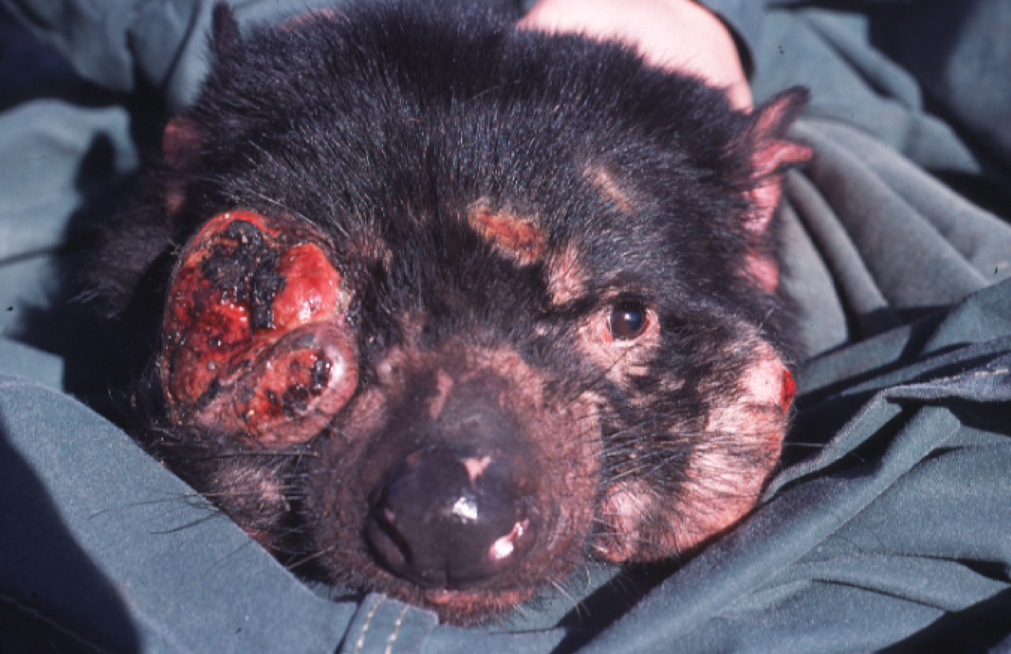
In 1996, a photographer in northeastern Tasmania captured the first recorded images of a Tasmanian devil (Sarcophilus harrisii) with grotesque tumors disfiguring its face. This was the world's first glimpse of Devil Facial Tumor Disease (DFTD), a bizarre and deadly condition that has since pushed the world's largest surviving carnivorous marsupial to the brink of extinction. DFTD is transmissible. It spreads not through a virus but as a contagious cell line passed directly from one devil to another through biting—a common behavior during their aggressive mating and feeding encounters.
The disease is an allograft, meaning the tumor cells themselves are the infectious agent, physically lodging in the wounds of a bitten devil and growing into new tumors. These tumors develop around the face and mouth, growing rapidly and often metastasizing to internal organs. The tumors become so large they interfere with feeding, leading to death by starvation, usually within months of symptoms appearing. The disease is almost universally fatal and has had a catastrophic impact on the devil population, causing declines of over 80% across Tasmania. At its peak in 1996, the wild devil population was estimated at 53,000; by 2020, it had fallen to around 17,000.
The Immortal Devil
Genetic analysis of tumors from devils across Tasmania revealed a startling fact: all the cancer cells were genetically identical. They were clones, not independent cancers arising in each new host. This means the disease originated in a single Tasmanian devil, likely a female, sometime before it was first documented in 1996. This "founder devil" is long dead, but its cancerous cell line has achieved a form of biological immortality, surviving as a parasite that colonizes new hosts.
This parasitic cancer performs a remarkable trick to survive. An animal's immune system would recognize foreign cells from another individual and destroy them. DFTD cells, however, evade detection by erasing their identity. They do this by down-regulating the production of Major Histocompatibility Complex (MHC) class I molecules on their surface. These molecules are a cellular barcode, and without them, the tumor cells are effectively invisible to the host's T-cells, allowing the allograft to grow unchecked.
In 2014, researchers discovered a second, genetically distinct transmissible cancer in devils in southeastern Tasmania, which they named DFT2. This new cancer, which arose from a male devil, is also contagious and demonstrates that this incredible evolutionary leap has happened more than once in this species. Both the original strain (DFT1) and DFT2 are believed to have originated from Schwann cells, which are cells that form the protective myelin sheath around nerve fibers.