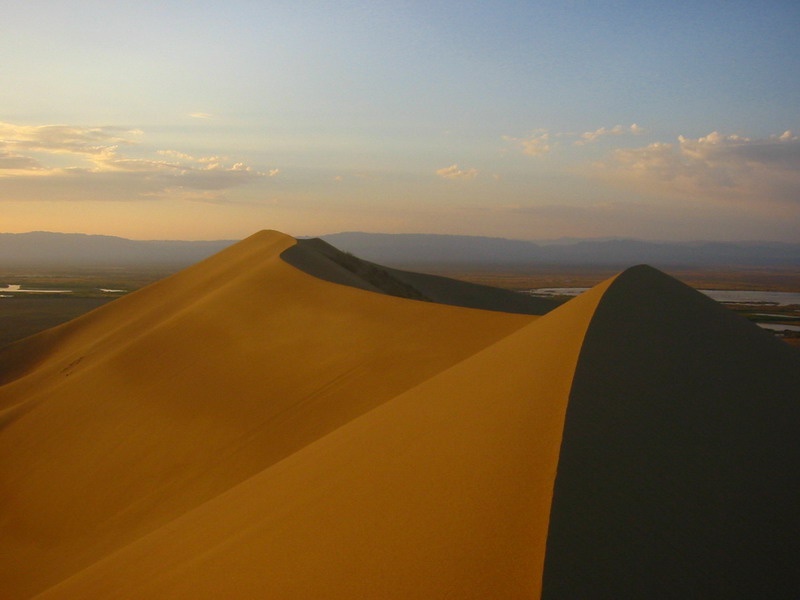
A Symphony of Sliding Sand
The Mingsha Shan, or "Echoing-Sand Mountain," is a series of dunes near the city of Dunhuang that exhibits a rare acoustic phenomenon. When wind conditions are right, or when people slide down the steep slopes, the sand releases a deep, resonant hum. This sound, which can last for several minutes, is not a friction noise. It is a complex physical process where an avalanche of sand grains synchronizes its vibrations, causing the entire dune to act like a massive natural loudspeaker. The sound can reach over 100 decibels—as loud as a motorcycle—and be heard up to 10 kilometers away.
The specific acoustic properties depend on a precise set of conditions. The sand grains must be nearly spherical, contain a high percentage of silica, and fall within a narrow size range, typically 0.1 to 0.5 millimeters in diameter. The humidity also must be very low, as moisture on the grains dampens the vibrations. The sound is generated by the shear motion between layers of sand. As the top layer slides over the stationary layer beneath, the grains collide and create vibrations. These vibrations form standing waves within the moving sand layer, which acts as a waveguide, amplifying the sound. The exact frequency of the hum, which can range from 70 to 105 Hertz, is thought to be determined by the collision rate of the grains and the thickness of the dry surface layer of sand.
An Oasis in Time
Adjacent to the singing dunes lies Yueyaquan, or Crescent Lake, a small, moon-shaped oasis that has existed for at least 2,000 years without being consumed by the surrounding desert. This geological peculiarity has its own physical explanation. The lake is located in a depression between tall dunes. Prevailing winds blow along the slopes of the dunes rather than directly over the lake, creating an airflow dynamic that blows sand away from the oasis instead of into it. For centuries, the lake was also replenished by a natural underground aquifer.
Historical records document the dunes' strange sounds for centuries. The Venetian merchant Marco Polo, traveling the Silk Road in the 13th century, described the sounds of the Gobi Desert. He attributed the noises to "evil spirits" and wrote that travelers could hear "the sounds of all kinds of musical instruments, and also of drums and the clash of arms". Local legends tell of a buried army whose battle cries can still be heard from beneath the sand. These historical accounts capture the mystery of a phenomenon that modern physics continues to investigate. The dunes stretch for about 40 kilometers east to west and 20 kilometers north to south, with some peaks reaching a height of 250 meters.