The planet's hum
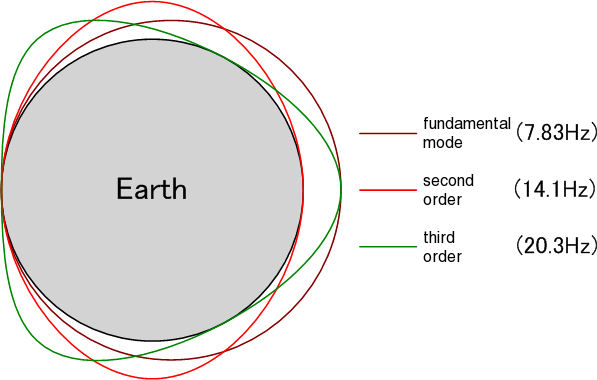
The space between Earth's surface and the ionosphere is a planetary-sized resonant cavity. This Earth-ionosphere waveguide is constantly energized by global lightning discharges—about 1,000 strikes every second. This enormous electrical activity generates extremely low-frequency (ELF) electromagnetic waves that travel around the planet, creating a series of standing waves. These peaks in the ELF spectrum are known as Schumann resonances.
The fundamental frequency of this resonance is approximately 7.83 Hz, a persistent hum that is called Earth's "heartbeat." Higher-order resonances also occur at predictable frequencies, typically around 14.3, 20.8, 27.3, and 33.8 Hz. The German physicist Winfried Otto Schumann first predicted this phenomenon mathematically in 1952, and his theories were confirmed by measurements in the early 1960s. The strength and exact frequency of these resonances are not static; they fluctuate based on the intensity and location of global lightning activity, seasonal changes, and disturbances in the ionosphere caused by solar events.
Listening in from Nagycenk
The Széchenyi István Geophysical Observatory, located near Nagycenk, was established in 1957. Operated by the Institute of Earth Physics and Space Science, it is a primary site in Hungary for monitoring the Earth's electromagnetic environment. Its location within the Fertő-Hanság National Park, on a thick layer of conductive sediment, shields its sensitive instruments from industrial electromagnetic noise.
Since May 1993, the observatory has continuously measured the vertical electric field component of the Schumann resonances. The equipment includes a specialized ball antenna and induction coils to detect the faint magnetic fields, which are orders of magnitude weaker than the Earth's background magnetic field. The amplitude of the Schumann resonance magnetic field is around 1 picotesla, while the Earth's static field is about 30-50 microteslas. By analyzing this data, scientists at Nagycenk can record changes in global weather patterns, monitor the health of the lower ionosphere, and study the effects of solar flares and other extraterrestrial events on our planet's atmosphere.