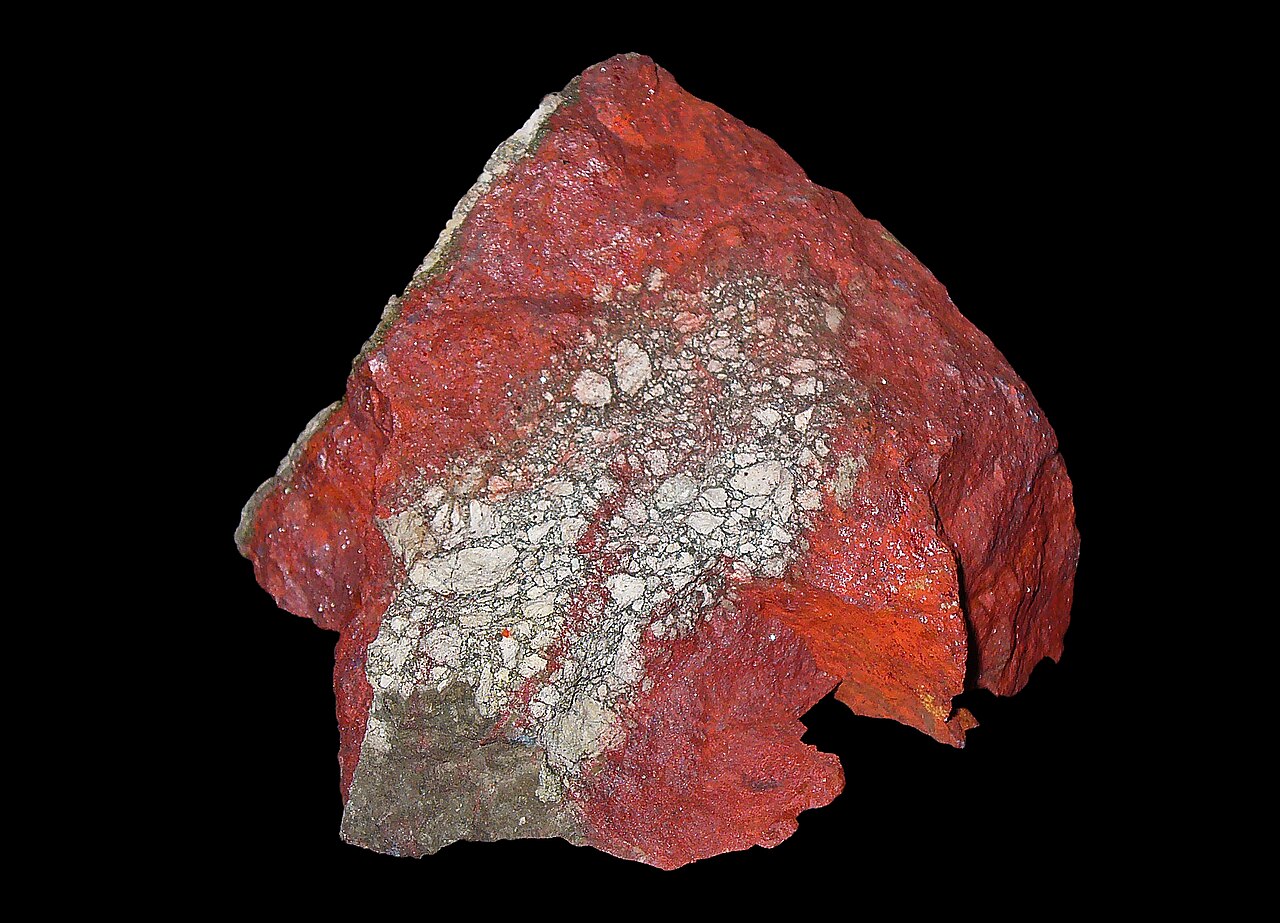
A Carboniferous ore body
Deep beneath the plains of central Kazakhstan lies the Sarybulak deposit, a massive concentration of the mercury sulfide mineral, cinnabar (HgS). This ore body formed approximately 300 million years ago, during the Carboniferous period. At that time, the region was tectonically active, part of a continental magmatic arc. This activity created extensive fault systems that were conduits for superheated water.
Geological analysis shows that hydrothermal fluids, heated to around 200°C, ascended from deep within the Earth's crust. These fluids carried dissolved mercury, sulfur, and other elements. As the fluids moved upward into cooler rock formations—primarily Devonian and Carboniferous limestones and shales—the change in temperature and pressure caused the dissolved minerals to precipitate. The mercury and sulfur combined to form cinnabar, which crystallized within the fractures and porous zones of the host rock. This process, occurring over a vast timescale, gradually built up one of the planet's significant mercury resources. The deposit is associated with other hydrothermal minerals like quartz, calcite, barite, and pyrite.
Geochemical fingerprints
Scientists understand the formation conditions of the Sarybulak deposit by studying microscopic clues trapped within the ore itself. The principal method is fluid inclusion analysis. Fluid inclusions are tiny, sealed pockets of the original 300-million-year-old hydrothermal water that became trapped inside growing crystals, particularly quartz that precipitated alongside the cinnabar. These inclusions are samples, providing a direct sample of the ore-forming fluid.
By heating and cooling these inclusions under a microscope, researchers can determine the temperature at which the fluid was trapped—known as the homogenization temperature—and its salinity. This data confirms the 200°C formation temperature and provides details about the fluid's chemical composition. Isotopic analysis of the mercury and sulfur helps trace the origins of these elements, suggesting they were leached from deeper crustal rocks by the circulating hydrothermal system. The specific geochemistry of Sarybulak is characteristic of an epithermal deposit, a class of ore bodies formed at relatively shallow depths and low temperatures from heated aqueous solutions.