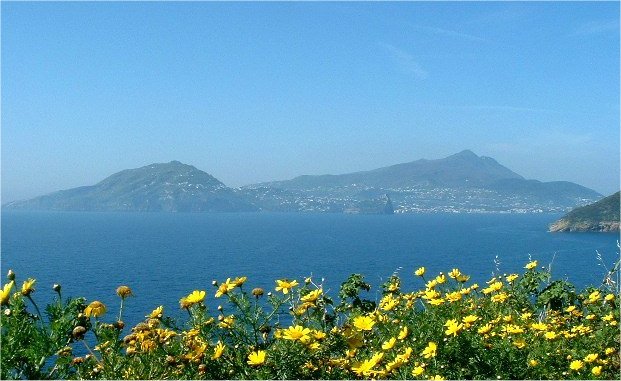
A resurgent volcanic dome
The highest point on the island of Ischia, Monte Epomeo, is not a typical volcano. It is a volcano-tectonic horst, an uplifted block of rock pushed up from below. This process, known as resurgence, began after a massive eruption approximately 55,000 years ago formed a caldera—a large basin-shaped depression. That eruption created a thick layer of rock called the Monte Epomeo Green Tuff, a type of welded ash that gives the mountain its distinctive color.
Following the caldera's collapse, the land was submerged beneath the sea. Then, beginning around 33,000 years ago, fresh magma began pushing the caldera floor upwards, lifting the Green Tuff more than 800 meters out of the water. This created the mountain visible today. The uplift was not uniform, creating a tilted block fragmented by faults. Evidence of this submarine past can be found high on the mountain's slopes, where marine fossils and ancient beach debris now sit 400-500 meters above sea level. This entire process makes Ischia one of the world's clearest examples of caldera resurgence.
An active and monitored system
Uplift of Monte Epomeo is not a relic of the distant past; it is an ongoing process. The island is continuously monitored by Italy's National Institute of Geophysics and Volcanology (INGV). A network of seismic stations, GPS, and tiltmeters tracks the ground deformation, which shows the island is still rising. This slow inflation is caused by a shallow, sill-like magma body a few kilometers beneath the surface that continues to fill, pressurizing the system from below.
This ongoing activity has consequences. The island has a history of destructive earthquakes, including a significant event in Casamicciola in 1883, linked to the stresses of this tectonic movement. The last volcanic eruption on the island occurred in 1302 A.D., creating the Arso lava flow on the northeastern coast. While the current alert level for Ischia is green, the combination of historical eruptions, seismic activity, and steady ground uplift indicates that the volcanic system is still very much active. The constant monitoring is for the 50,000 people who live on the island.