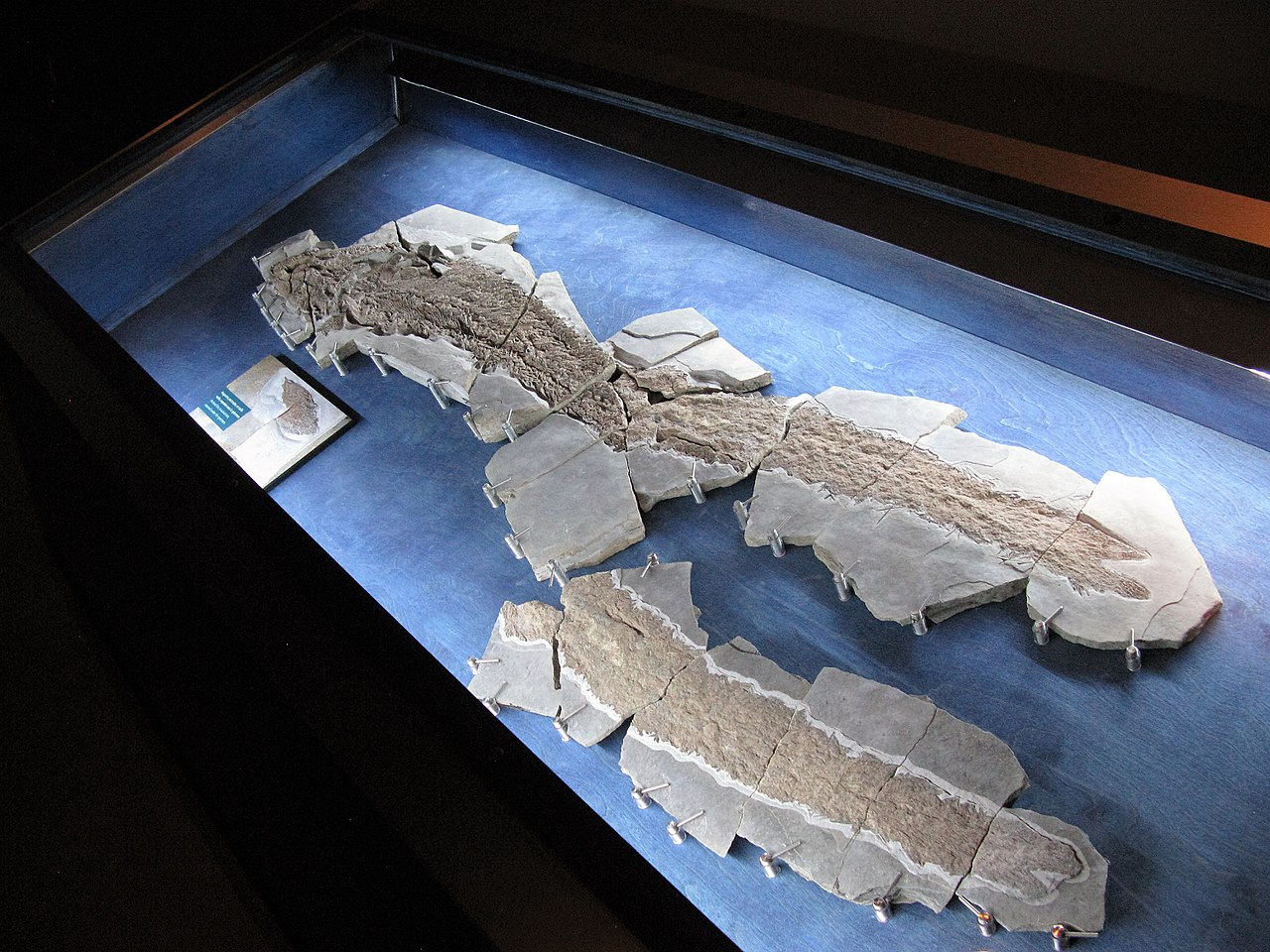
Where 380-million-year-old cliffs preserve the moment fish began crawling onto land. Fossils show the transition from fins to limbs, including Elpistostege, a fish with finger bones in its fins. This is where your ancestors left the water and began the lineage leading to all land vertebrates.
Placoderm2, CC BY-SA 4.0, via Wikimedia Commons
The Age of Fishes in stone
The cliffs of Miguasha National Park are preserves a 380-million-year-old ecosystem. These layers of sedimentary rock, known as the Escuminac Formation, safeguard an unusually complete fossil record of the Devonian Period. At that time, this part of Quebec was a warm, tropical estuary. The fine-grained sediment of the ancient seabed created ideal conditions for preservation, leading to the site containing the world's most abundant and well-preserved collection of lobe-finned fish fossils. These are the fish that would eventually give rise to all four-legged land animals, or tetrapods.
The site is so significant that it was designated a UNESCO World Heritage Site in 1999. The Escuminac Formation holds fossils representing five of the six major fish groups from the Devonian. Over 18,000 fossil specimens have been identified at Miguasha, offering a nearly complete picture of this ancient environment. The fossils are numerous; many are complete, three-dimensional specimens that even include fossilized soft tissues, providing incredible detail for scientific study.
From fin to hand
The park's most famous resident is Elpistostege watsoni, a transitional fossil that illuminates the evolution of the vertebrate hand. For decades, scientists had only partial skulls of this large, predatory fish. Then, in 2010, a complete, 1.57-meter-long specimen was discovered. High-energy CT scans of its pectoral fin revealed an anatomical structure that was startlingly familiar: it contained bones homologous to the human arm (humerus), forearm (radius and ulna), wrist (carpus), and fingers (phalanges).
Elpistostege is the first known fish to show finger bones locked inside a fin that still possessed fin-rays. This anatomical arrangement allowed for greater flexibility, likely enabling the fish to support its weight in shallow water. Another important species found here is Eusthenopteron foordi, nicknamed the "Prince of Miguasha". For nearly a century, its limb-like fins made it a textbook example of the fish-to-tetrapod transition. The sheer quantity and quality of these fossils allow paleontologists to trace the incremental changes that transformed a fish's fin into a limb capable of walking on land.
💡Fun Facts
The first fossils at Miguasha were discovered in 1842 by geologist Abraham Gesner.
Some fossils of the fish *Eusthenopteron* show evidence of cannibalism.
The park hosts the only fully intact specimen of *Elpistostege watsoni* ever discovered in the world.
Fossils of early plants, scorpions, and a millipede have also been found, providing context for the ancient ecosystem.