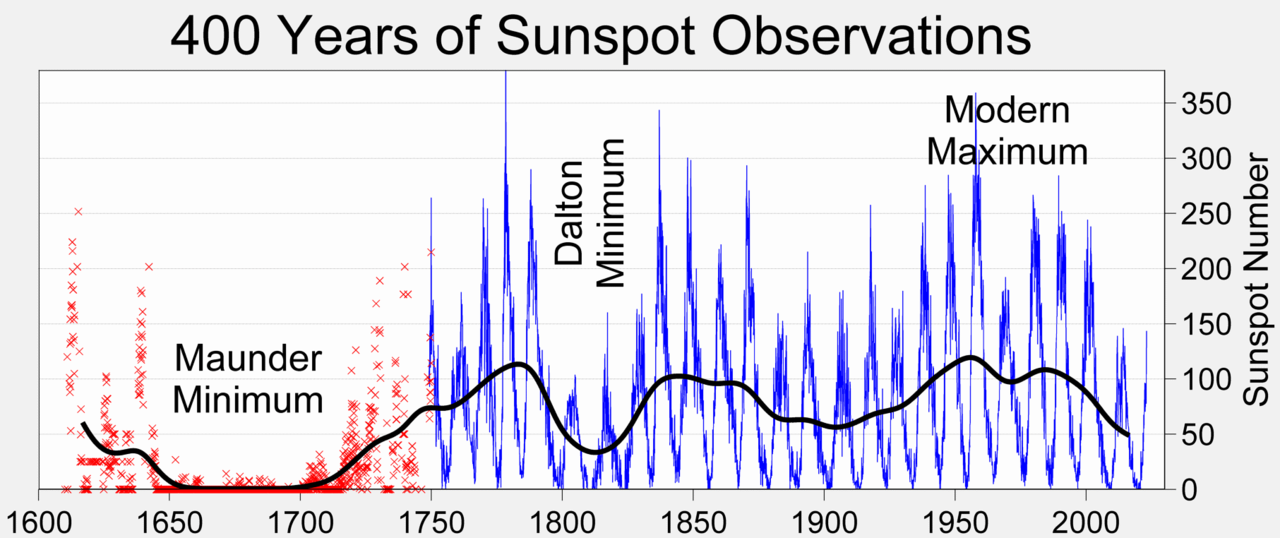
A 70-year solar silence
Between 1645 and 1715, astronomers pointed their telescopes at the sun and saw almost nothing. Sunspots, the dark patches of intense magnetic activity that typically appear in an 11-year cycle, had vanished. For periods as long as a decade, observers recorded no spots at all. Over one 30-year span, they counted fewer than 50, whereas a typical count for that duration would be 40,000 to 50,000. This period of solar quiet is the Maunder Minimum, named for the astronomer Edward Walter Maunder who identified the anomaly in historical records.
This solar event coincided with the most intense phase of a period of global cooling known as the "Little Ice Age". In the Swiss Alps, glaciers advanced, threatening farms and villages. Rivers across Europe, including the Thames in London, frequently froze solid. The link between the quiet sun and the cold Earth was long suspected, but the definitive proof lies silent and preserved within the wood of ancient trees growing in the high-altitude forests of Switzerland.
A story written in wood
Dendroclimatology is the science of determining past climates from tree rings. Each year, a tree adds a new layer of growth, and the characteristics of that ring—its width, density, and isotopic composition—record the environmental conditions of that year. Trees in sensitive, high-altitude environments like the Swiss Alps are climate archives. Here, the European Larch (Larix decidua) grows slowly, its development limited primarily by summer temperatures. A cold, short summer produces a narrow, dense ring; a warm, long summer produces a wider one.
Studies of larch trees from the Swiss Alps show a distinct period of suppressed growth during the Maunder Minimum. The narrow rings are a direct physical record of the colder temperatures that gripped the region. The mechanism is straightforward: lower solar activity caused a decrease in the sun's energy output, which in turn cooled the Northern Hemisphere. Average temperatures in this hemisphere may have dropped by as much as 0.6°C (1.1°F).
The tree rings offer another, more direct line of proof. With the sun's magnetic field weakened, more high-energy galactic cosmic rays penetrated Earth's atmosphere. These cosmic rays collide with atmospheric atoms to produce specific isotopes, including Carbon-14. This radioactive isotope is then absorbed by trees through photosynthesis and incorporated into their rings. Analysis of tree rings from 1645-1715 shows a marked increase in Carbon-14, confirming that the sun's protective magnetic shield was down. This isotopic signature, locked in the wood, provides an independent verification of the sun's unusual behavior.