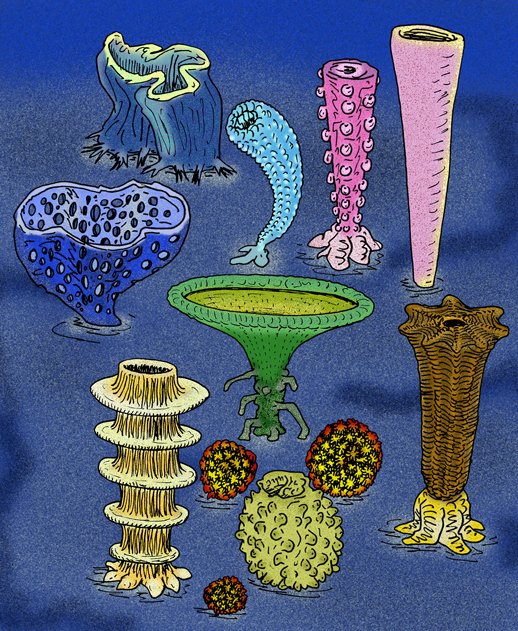
A reef built by ancient animals
The sea stack known as Pan di Zucchero, off the coast of Masua, records deep time. It stands 133 meters tall and is composed of almost pure Cambrian limestone. This limestone is the fossilized remains of a reef that grew in a shallow sea roughly 530 million years ago. The organisms that built this structure were Archaeocyathids, a group of extinct, sponge-like animals. These creatures were among the very first animals to build skeletons, and they formed Earth's first-ever reefs.
Archaeocyathids had conical or tubular shapes, with a porous, double-walled calcite skeleton. They were filter feeders, drawing water through their porous bodies to capture nutrients, much like modern sponges. They flourished worldwide during the Early Cambrian period but vanished by the Middle Cambrian, making formations like Pan di Zucchero records early animal evolution. The rock belongs to the Nebida Group and Gonnesa Group formations, which document a transition from a siliciclastic environment to a shallow carbonate platform. This geological setting was ideal for the proliferation of these reef-builders.
From seabed to sea stack
The transformation from a 530-million-year-old reef on the seafloor to a towering sea stack involved immense geological forces and erosion. After the reef-forming organisms died, their calcium carbonate skeletons, along with other sediments, were buried and eventually lithified into limestone. Tectonic movements associated with the Hercynian and later orogenies lifted these ancient seabeds far above sea level.
Once exposed, the forces of erosion began to sculpt the landscape. The stack was separated from the mainland by marine erosion, which wore away softer surrounding rock, leaving the harder, more resistant Cambrian limestone core standing alone. This process of differential erosion created the dramatic coastal cliffs and sea stacks that define the Iglesiente coastline. Karst phenomena, the chemical dissolution of the limestone by rainwater, further shaped the stack, creating two large sea caves at its base. One of these caves is large enough for small boats to pass through. The same geological formations that host these ancient reefs also contain lead and zinc deposits, which led to the development of the extensive mining industry in the region, including the famous Porto Flavia mine visible directly opposite the stack.