LimnologyRwanda / Democratic Republic of the Congo
A 300 Billion Cubic Meter Gas Bomb
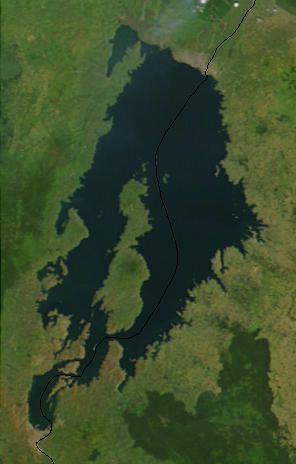
A lake containing 300 billion cubic meters of dissolved methane. A limnic eruption like Lake Nyos could release enough gas to suffocate millions.
NASA, Public domain, via Wikimedia Commons
The explosive lake
Lake Kivu, one of Africa's Great Lakes, holds a vast and dangerous quantity of dissolved gas. Deep within its waters, at depths below 260 meters, an estimated 60 billion cubic meters of methane and 300 billion cubic meters of carbon dioxide are trapped by the immense pressure of the water above. This situation makes Kivu one of only three known "exploding lakes" in the world, alongside Lakes Nyos and Monoun in Cameroon.
The lake's unique properties are a result of its location in the East African Rift Valley, a volcanically active area. Volcanic vents on the lake floor release carbon dioxide into the deep water. Microorganisms then metabolize some of this CO2, producing methane as a byproduct. The lake is strongly stratified, meaning its water layers do not mix. A dense, saline deep layer, called the monimolimnion, is permanently separated from the oxygenated surface waters (the top 60 meters) that support the lake's fish and aquatic life. This stratification acts as a cap, preventing the gases from escaping and allowing them to accumulate to near-saturation levels over hundreds of years. Evidence from lake sediments suggests that massive outgassing events may have caused local extinctions around every thousand years.
Taming the beast
A disturbance, such as a major earthquake or a volcanic eruption from the nearby Mount Nyiragongo, could trigger a catastrophic limnic eruption. Such an event would violently displace the deep, gas-rich water, causing the dissolved methane and CO2 to erupt out of solution. The resulting cloud of dense gas, heavier than air, would flow across the landscape, suffocating the two million people who live in the lake basin. A similar, though smaller, event at Lake Nyos in 1986 released a CO2 cloud that killed approximately 1,746 people and 3,500 livestock. Lake Kivu contains thousands of times more gas than Lake Nyos did.
To mitigate this risk, and to harness a valuable energy resource, Rwanda has developed innovative methane extraction facilities. The KivuWatt project, a floating gas extraction platform, began commercial operations in 2015. The facility sits on a barge 13 kilometers offshore and works by pumping up gas-laden water from a depth of over 300 meters. As the water rises, the pressure drops, and the dissolved gases bubble out. The raw gas is then washed to produce clean methane, which is piped to an onshore power plant to generate electricity. In its first phase, the plant produces 26 megawatts for the local grid. This process provides a renewable energy source and gradually reduces the concentration of gas in the lake, making the region safer.
💡Fun Facts
The lake is "meromictic," a scientific term for a body of water whose layers do not mix.
The methane in Lake Kivu is produced by the microbial reduction of volcanic CO2.
The KivuWatt project was the world's first floating gas extraction platform on a lake.
The amount of methane in the lake is enough to generate an estimated 700 MW of electricity over 55 years.