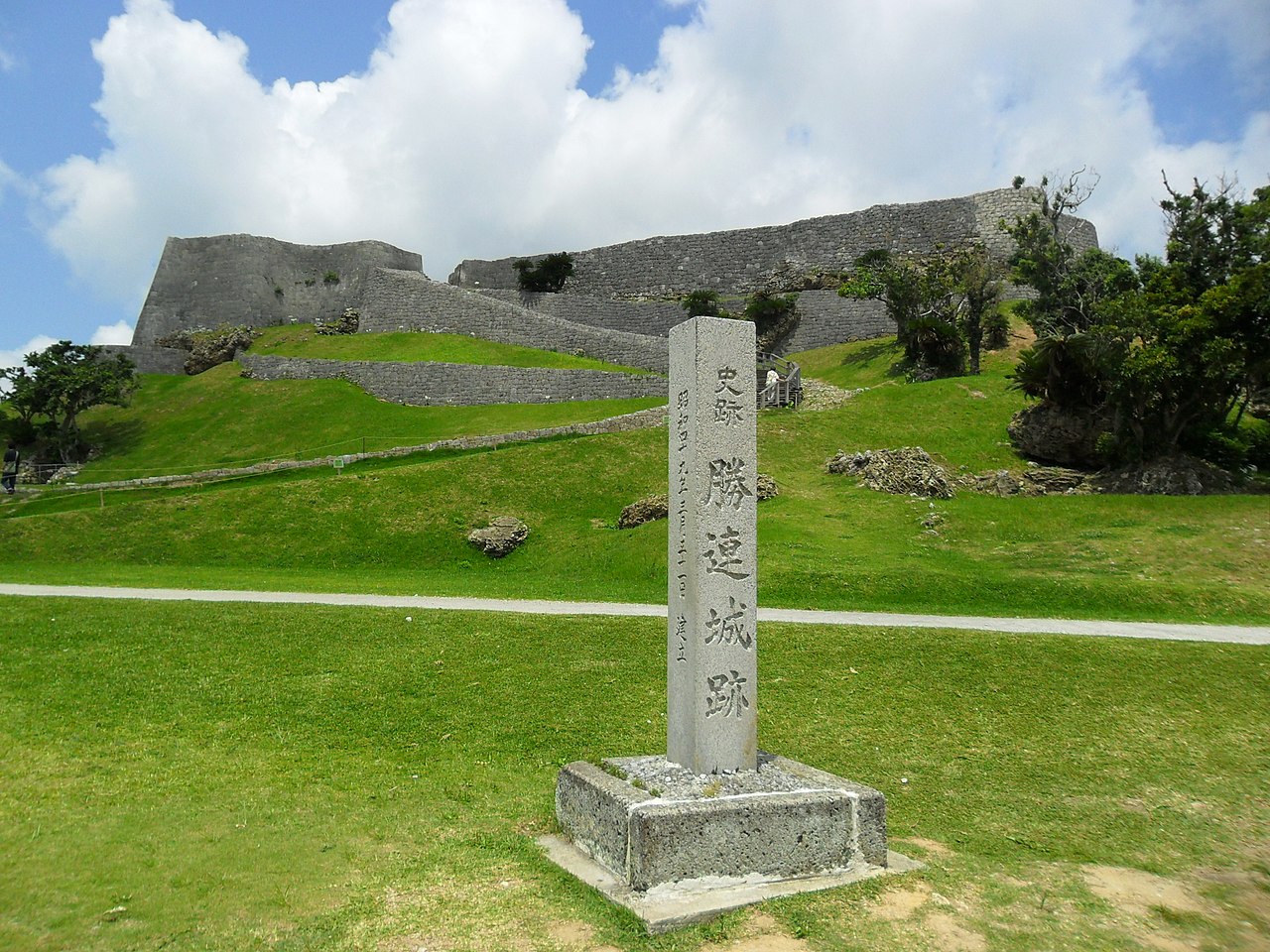
A Fortress of Fitted Stone
Katsuren Castle is a gusuku—an Okinawan fortress—built upon a hill of Ryukyuan limestone 98 meters above sea level. Its construction dates to the 13th and 14th centuries, and its walls show great skill in adapting construction to the natural landscape. The builders used the local porous limestone to create four tiered enclosures, or kuruwa, that ascend the hill's natural contours. This design creates a series of steep, defensible stone stairways leading to the highest point.
The masonry itself shows a sophisticated understanding of stoneworking. The walls are built primarily with a technique called nozura-zumi, where masons fit rough, irregular stones together without mortar. This dry-stone method proved durable enough to withstand centuries of typhoons. Other sections of the castle display more advanced techniques, such as nuno-zumi and the tortoiseshell-patterned aikata-zumi, which use more precisely dressed stones. The elegant curves of the walls are a feature of gusuku architecture, blending fortifications with the underlying terrain.
An Architectural Independence
The gates of Katsuren Castle have a distinct architectural feature: stone arches. This is a significant departure from the architectural traditions of mainland Japan, where castle gates from the same period almost exclusively used post-and-lintel systems made of wood. The Okinawan masons developed their arch-building techniques independently. Gates are incorporated directly into the limestone walls, with blocks precisely cut and fitted to form a stable, load-bearing arch.
The castle reached its peak of influence in the mid-15th century under the rule of Lord Amawari. At this time, Katsuren was a major hub for maritime trade. Excavations have uncovered a wealth of artifacts, including Chinese ceramics, Southeast Asian pottery, and even ancient Roman and Ottoman coins, confirming the castle's role as a connection point for international trade routes. This global connection did not erase its unique architectural identity. The castle's stonework and arches remain a product of local Ryukyuan engineering, developed in isolation from the architectural norms of its powerful neighbors. The entire site was designated a UNESCO World Heritage Site in 2000.