A System of Sonic Information
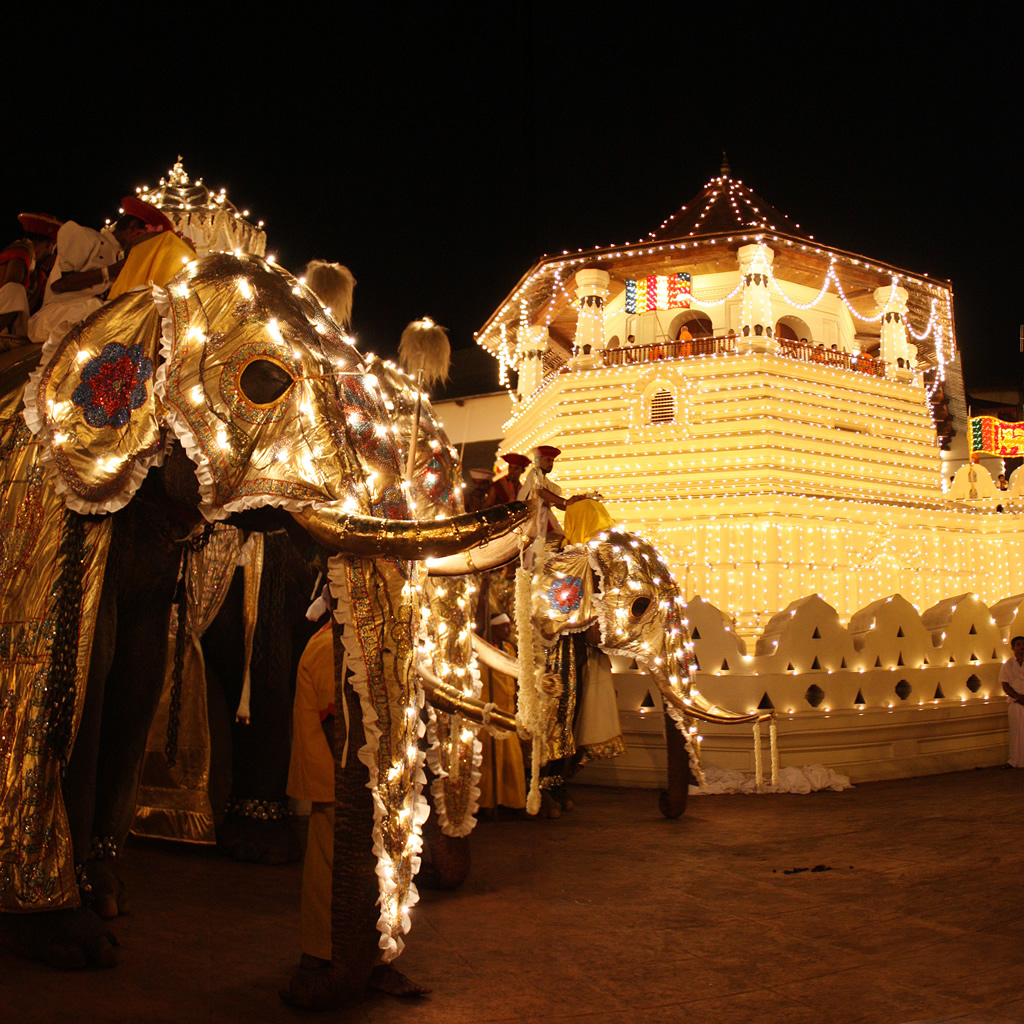
The Kandy Esala Perahera is an annual ten-day festival honoring the Sacred Tooth Relic of the Buddha, which is housed in the Sri Dalada Maligawa, or Temple of the Sacred Tooth Relic, in Kandy. This grand procession features whip-crackers, flag bearers, dancers, and many elephants adorned in lavish costumes. At the core of the event is a sophisticated system of auditory communication, where drumming is musical accompaniment and transmits information. The specific rhythms and beats convey messages, set the tone for different phases of a ritual, and signal upcoming sequences to the hundreds of performers.
This system operates through a specialized ensemble of traditional percussion instruments. The main drum for Kandyan dance is the geta beraya, a double-headed drum played with both hands that produces a wide range of tones. It is accompanied by the dawula, a cylindrical drum, and the tammattama, a pair of kettle drums played with sticks. These instruments, along with the horanewa (a type of oboe), form the hevisi music that is central to the festival's proceedings. Musicologists studying the Perahera have identified rhythmic patterns, or padams, that correspond to specific actions and participants. For example, a particular rhythm announces the approach of the Maligawa Tusker, the lead elephant carrying the casket for the relic, allowing other performers to adjust their movements accordingly. The entire procession's structure is coordinated through this shared, orally transmitted language of rhythm.
Embodied Memory and Oral Transmission
The knowledge of the Perahera's complex rhythmic structures is passed down through generations of drummers without written notation. This is a system of physical memory, where hundreds of complex patterns are retained and recalled through physical practice from a young age. This oral tradition has preserved the sonic identity and ritualistic nature of the Perahera for centuries. Research in cognitive science suggests that rhythmic patterns can improve recognition and memory encoding, providing a potential neurological basis for the stability of such long-standing oral traditions.
The drumming clans, often from specific villages, have been stewards of this tradition for generations. A young drummer learns from a master, gradually absorbing the vast repertoire needed for the ten-day festival. Each night of the Perahera, which consists of the five-day Kumbal Perahera followed by the five-day Randoli Perahera, has its own specific sequences and corresponding drum patterns. The precision required from the thousand or so performers in the procession depends entirely on this non-written system of cues. The drumming is a timekeeping and sequencing mechanism that has ensured the consistent performance of one of the world's oldest and most elaborate cultural events.