From cosmic rays to the Cold War
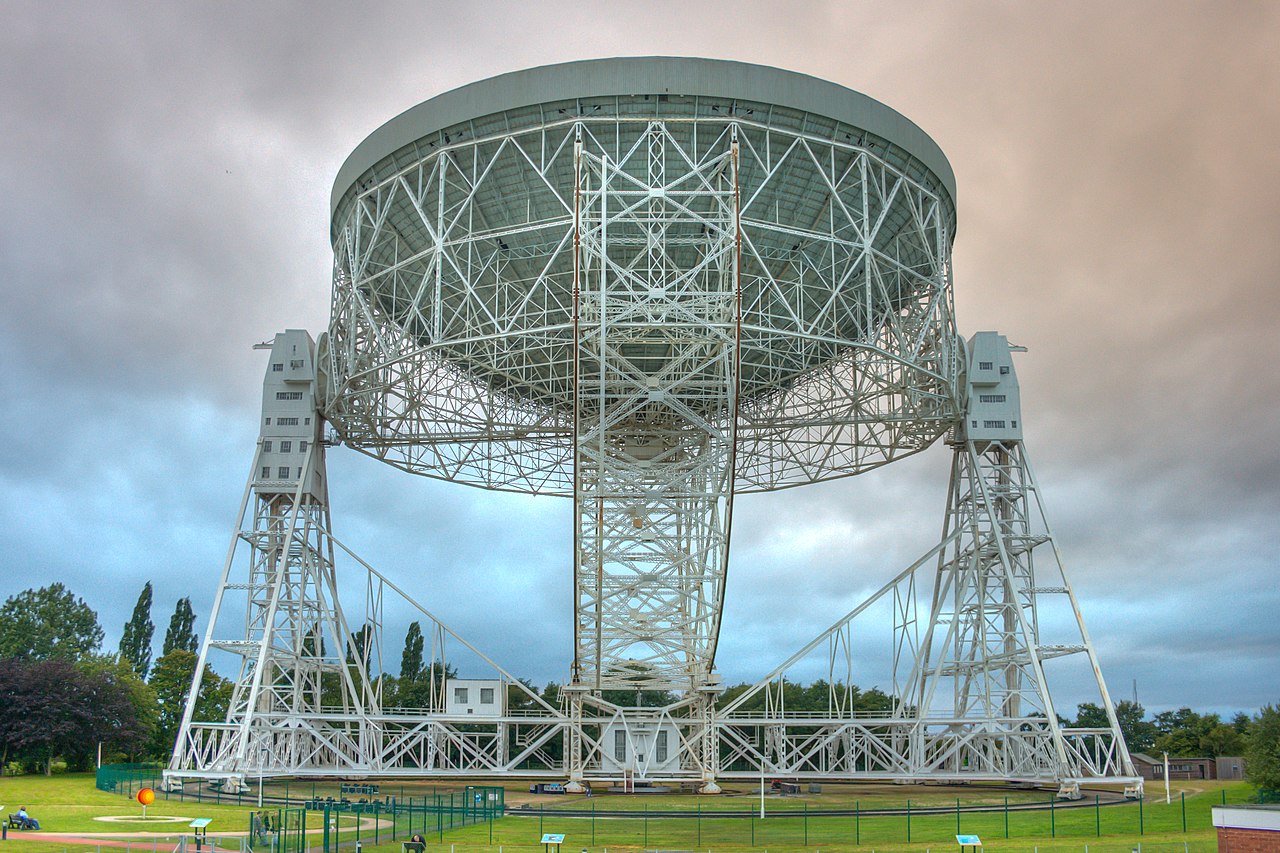
In October 1957, the brand-new, 76.2-meter radio telescope at Jodrell Bank was a project in trouble. Conceived by Sir Bernard Lovell to study cosmic rays, the massive instrument, then the world's largest steerable telescope—was hugely over-budget, and facing intense scrutiny. Then, on October 4, the Soviet Union launched Sputnik 1. While amateur radio operators could detect the satellite's beeps, only Jodrell Bank had the power to detect its carrier rocket with radar. Suddenly, the controversial astronomical instrument had a new urgent purpose. On October 11, after frantic improvisation, Lovell's team successfully tracked the rocket, which was an intercontinental ballistic missile. This confirmed the Soviets' technological leap and established the telescope as an important intelligence asset.
The instrument, originally known as the Mark I and later renamed the Lovell Telescope, became a player in the Space Race. It tracked both Soviet and American probes, and in 1966 it received the first images transmitted from the surface of the Moon by the Soviet Luna 9 probe. Its work provided the West with independent verification of space missions at a time of intense secrecy. The telescope's bowl alone weighs 1,500 tonnes, with the entire structure weighing 3,200 tonnes. Its construction, which began in 1952, was a monumental feat of engineering led by Charles Husband.
The deep universe
Beyond its unplanned role in geopolitics, the Lovell Telescope has been central to radio astronomy for over six decades. The observatory, established by Lovell in 1945, moved from studying meteors with surplus WWII radar equipment to probing the deepest questions about the universe. Jodrell Bank's instruments made critical contributions to the discovery and understanding of quasars and pulsars. The observatory was also instrumental in confirming Albert Einstein's theory of general relativity through its work on gravitational lensing, the bending of spacetime around massive objects.
Today, Jodrell Bank remains a world-leading facility. It is the control hub for the e-MERLIN network, an array of seven UK-based radio telescopes that work together as a single instrument, with a maximum baseline of 217 kilometers, providing exceptionally high-resolution images. It also hosts the global headquarters of the Square Kilometre Array (SKA) project, an international effort to build the world's largest radio telescope, with arrays in South Africa and Australia. In recognition of its scientific legacy and its role in the dawn of the space age, Jodrell Bank was designated a UNESCO World Heritage Site in 2019.