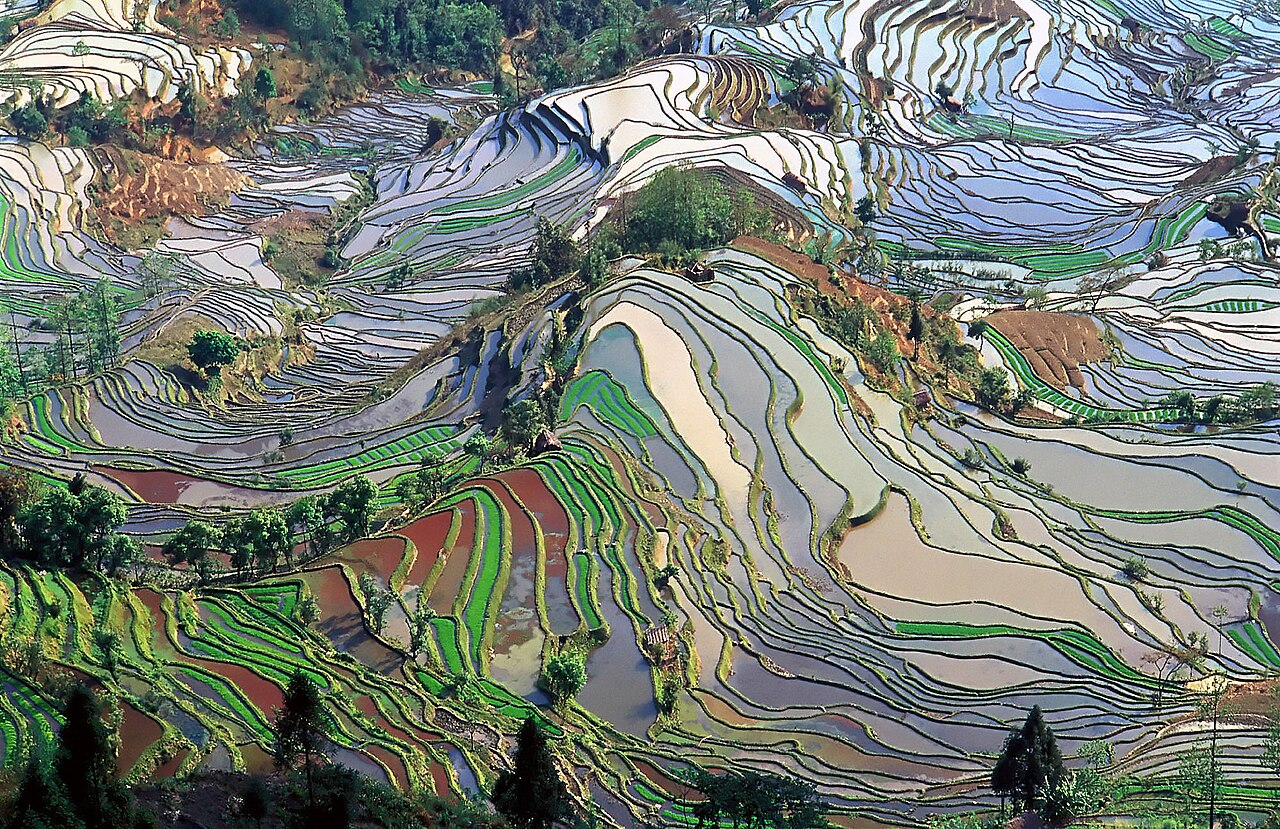
A four-part ecological engine
The Honghe Hani Rice Terraces are an ancient and exceptionally resilient agricultural system, operating continuously for at least 1,300 years. Located on the southern slopes of the Ailao Mountains, the terraces cascade down towards the Hong River, with some slopes containing as many as 3,000 distinct levels. The entire 16,603-hectare area functions as a balanced, gravity-fed hydrological network. This system is built on an integrated, four-part structure of forests, villages, terraces, and the river.
At the highest elevations, from roughly 2,000 to 2,900 meters, are conserved mountaintop forests. These forests act as a natural reservoir, capturing and storing vast amounts of rainfall from the region's subtropical monsoon climate. Just below the forests, between 1,400 and 2,000 meters, the Hani people built their 82 villages. The villages are located to intercept spring water released from the forest catchment. A complex system of channels and ditches then guides this water, along with runoff from the villages, down to the terraces below. The terraces themselves are the center of the system, retaining water and soil. Finally, any runoff drains into the Hong River at the bottom of the valley, where water evaporates, rises, and returns to the mountain forests as clouds and rain, completing the cycle.