An evolutionary laboratory
Hachijō-jima, an island 287 kilometers south of central Tokyo, is a natural experiment in evolution. The island is a composite volcano, formed by two separate stratovolcanoes joined by a lowland area. The older, heavily eroded southeastern peak is Mihara-yama (also called Higashi-yama), which began its activity over 100,000 years ago. The younger, conical northwestern peak is Hachijō-fuji (Nishi-yama), the tallest peak in the Izu Islands at 854.3 meters, which became active thousands of years ago with eruptions continuing into the 1600s.
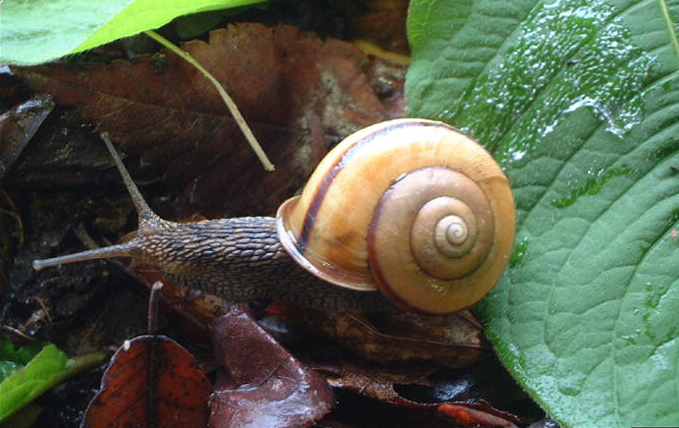
This unique geology enabled a remarkable case of adaptive radiation. A single ancestral species of land snail from the genus Euhadra colonized the island. Over time, the rugged terrain and repeated lava flows from the two volcanic peaks created isolated habitats. Valleys separated by volcanic ridges became evolutionary pockets where snail populations could diverge. This separation prevented gene flow, allowing different groups to evolve independently in response to their specific local environments. The result is the Euhadra grata species complex, a collection of fourteen distinct species that all descended from that original colonist.
Speciation in shell and strategy
The diversification of Hachijō-jima's snails shows in their physical forms and behaviors. The fourteen species show significant variation in shell shape and thickness, each adapted to a different ecological niche. Some species are arboreal, living on trees, while others are terrestrial, dwelling on the forest floor. These differences reflect distinct survival strategies.
Predation, particularly from carabid beetles, drove this evolution. Some snail species evolved large, globular shells thick enough to resist the beetles' crushing mandibles. Others developed flat, discus-shaped shells, which allow them to hide from predators in tight rock crevices or under tree bark where the beetles cannot reach them. This divergence into "crush-resistant" and "crevice-hiding" forms happened independently in different isolated valleys across the island. The research of biologist Satoshi Chiba has been fundamental to documenting this radiation, showing how geological barriers and predator-prey dynamics can produce significant biodiversity in a short evolutionary timeframe.