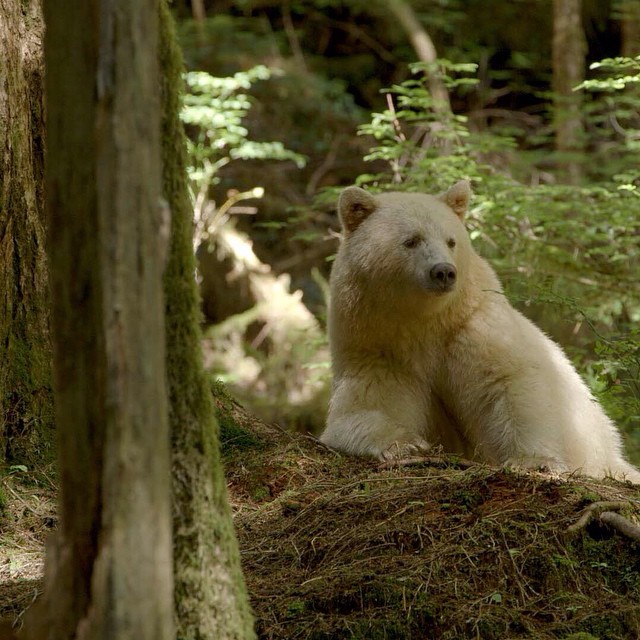
A product of rare genetics
In the Great Bear Rainforest of British Columbia, a rare, white-furred variant of the American black bear (Ursus americanus) roams the old-growth forests. Known as the spirit bear or Kermode bear (Ursus americanus kermodei), this animal is not an albino and is it related to polar bears. Its distinctive creamy-white coat is the result of a double recessive allele in a single gene: the melanocortin 1 receptor (MC1R) gene, which is involved in melanin production. For a cub to be born white, it must inherit this specific gene variant from both of its parents. Black-coated Kermode bears can carry a single copy of the gene, meaning two black bears can produce a white cub.
The genetics of the spirit bear show population genetics in a specific, isolated environment. While rare on the mainland, the recessive gene is surprisingly common on the islands of the Great Bear Rainforest. On Gribbell and Princess Royal Islands, between 10% and 30% of the black bear population has the white coat. The total number of spirit bears is estimated to be between 50 and 150 individuals. This high frequency in a concentrated area is likely due to genetic isolation on the islands, where bears have less genetic mixing with mainland populations. Unlike albino animals, spirit bears have pigmented skin and dark eyes.
An evolutionary edge and cultural icon
The white coat provides an unexpected advantage. Research has shown that spirit bears are more successful at catching salmon during daylight hours compared to their black-coated counterparts. One study suggested they are up to 30% more efficient because their lighter color is less visible to fish against the backdrop of a cloudy sky. This gives them a distinct foraging advantage in the salmon-rich rivers that define the ecosystem. The bears, in turn, contribute to the health of the rainforest by dragging salmon carcasses into the forest, which fertilizes the soil with marine-derived nitrogen.
The spirit bear, called Moksgm'ol in the Tsimshian languages, is culturally important to the First Nations of the region, including the Kitasoo/Xai'xais and Gitga'at peoples. For millennia, they kept the bear's existence a secret from the outside world to protect it. One Kitasoo/Xai'xais oral tradition tells of Raven, the creator, who made every tenth black bear white to represent the last ice age. These bears were never hunted and were held in reverence.
Conservation of this rare animal is tied to the protection of its habitat. The Great Bear Rainforest is one of the world's largest remaining tracts of intact temperate rainforest, covering 6.4 million hectares. In 2016, the Great Bear Rainforest Agreement was established, protecting 85% of the forest from industrial logging and giving First Nations a greater role in co-managing the territory.