A circulatory disappearing act
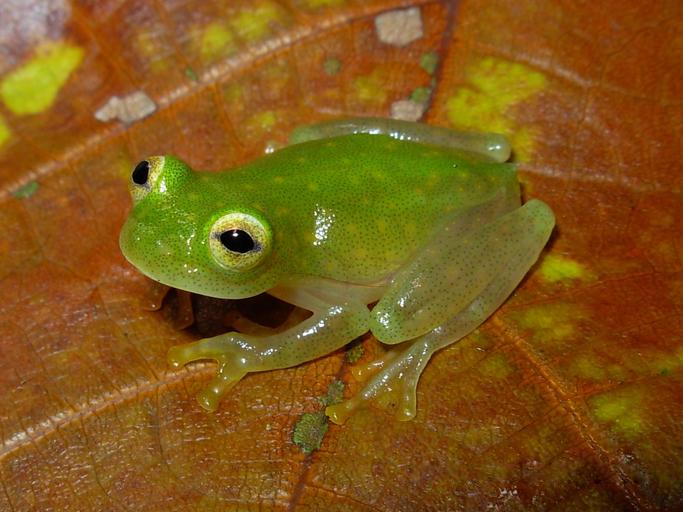
In the cloud forests of Costa Rica, a small amphibian performs an incredible physiological feat every day. The Fleischmann's glass frog (Hyalinobatrachium fleischmanni) achieves near-invisibility while it sleeps by actively removing its red blood cells from circulation. This nocturnal frog, measuring only 19 to 32 millimeters, spends its days sleeping upside down on the underside of broad leaves. To a predator looking up, a frog full of red blood would be conspicuous against the green leaf. To solve this, the frog temporarily packs away almost all of its most visible cells.
Using a technique called photoacoustic imaging, which uses light to generate ultrasonic waves from red blood cells, researchers tracked the frog's circulatory system. They found that when a glass frog goes to sleep, it removes approximately 89% of its red blood cells from its bloodstream. These cells are sequestered inside its liver, which is covered in reflective guanine crystals that help shield the red cells from view. This process increases the frog's transparency by two to three times, making it between 34 and 61 percent more see-through than when it is awake and active. Once the frog awakens, the red blood cells are released back into the bloodstream, and the animal becomes opaque again.
A biomedical puzzle
The glass frog's ability to pack and unpack its red blood cells daily without forming dangerous blood clots is of significant interest to medical researchers. In most vertebrates, such a high concentration of red blood cells would lead to thrombosis, a potentially fatal condition. The liver itself must also accommodate this daily influx, swelling by about 40% to hold the stored cells. How these frogs manage this extreme physiological change without suffering from clots or tissue damage is not yet understood.
This mechanism is camouflage called "edge diffusion." While the frog's back is green to match leaves, its legs are more translucent. By tucking its see-through legs around its body while at rest, the frog blurs the hard outline that a predator's visual system would normally detect. The combination of a green back, translucent limbs, and a circulatory system that can temporarily vanish is why the frog a master of daytime concealment on land—a rare feat, as most transparent animals live in water. There are over 150 species of glass frog, with 13 found in Costa Rica, and this remarkable adaptation is important for their survival in the dense, predator-filled rainforest.