A stumble in the mud
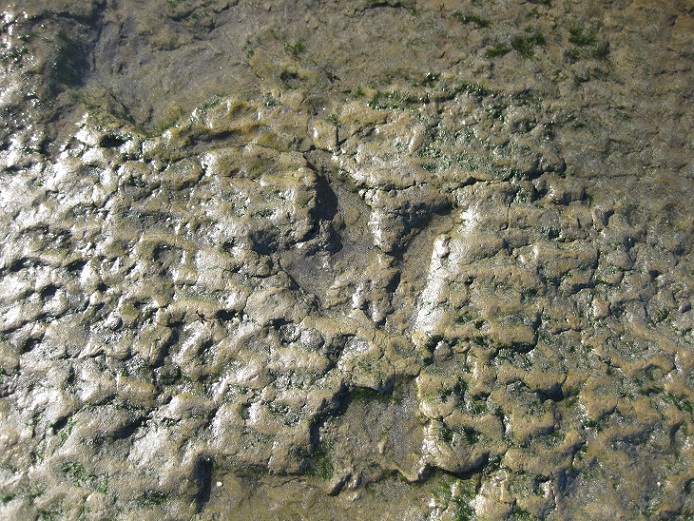
One hundred and ten million years ago, during the Early Cretaceous period, a large, plant-eating dinosaur walked across a muddy shoreline in what is now Surrey. This creature, likely an iguanodontid, was heavy, potentially weighing several tons. The ground beneath its feet was a thick, slick deposit of Gault clay—a sediment forming in a shallow, calm sea that covered much of southern England. As the dinosaur moved, one of its three-toed feet slid out from under it. The tracks left behind show an elongated impression, a deep gouge from the heel, and then a sequence of prints where the animal regained its footing. This trackway provides a rare record of an animal's interaction with a difficult environment, a moment of instability captured in stone.
The Gault Formation is a layer of stiff, blue-grey clay known for its exceptional fossil preservation. The fine-grained sediment is ideal for capturing detail, but its consistency would have made it a treacherous surface for a multi-ton animal. The slip demonstrates the physical challenge of moving across this substrate. Ichnology, the study of trace fossils like footprints, allows scientists to analyze these events. The shape and depth of the tracks reveal information about the dinosaur's weight, the speed it was moving, and the mechanics of its recovery from the slip.
A clay archive of ancient life
The dinosaur's stumble is one story held within Surrey's clay deposits. The Gault Formation and the underlying Weald Clay are fossil beds that show the Early Cretaceous ecosystem. The clay itself is primarily a marine deposit, filled with the fossils of sea creatures like coiled ammonites, belemnites, and the teeth of various sharks.
The dinosaur prints and occasional bones found here belong to animals that lived on the landmass adjacent to this ancient sea. Discoveries have been made in local clay quarries, such as the Smokejacks Brickworks near Ockley, which has operated for nearly a century. This specific location is famous for yielding skeletons of Iguanodon and, the first specimen of Baryonyx walkeri in 1983. Baryonyx was a large, carnivorous dinosaur with crocodile-like jaws and a formidable 30-centimeter claw on its thumb, believed to be a specialized fish-eater. The presence of both terrestrial dinosaurs and abundant marine life illustrates the environment of the time: a swampy coastal plain bordering a shallow ocean.