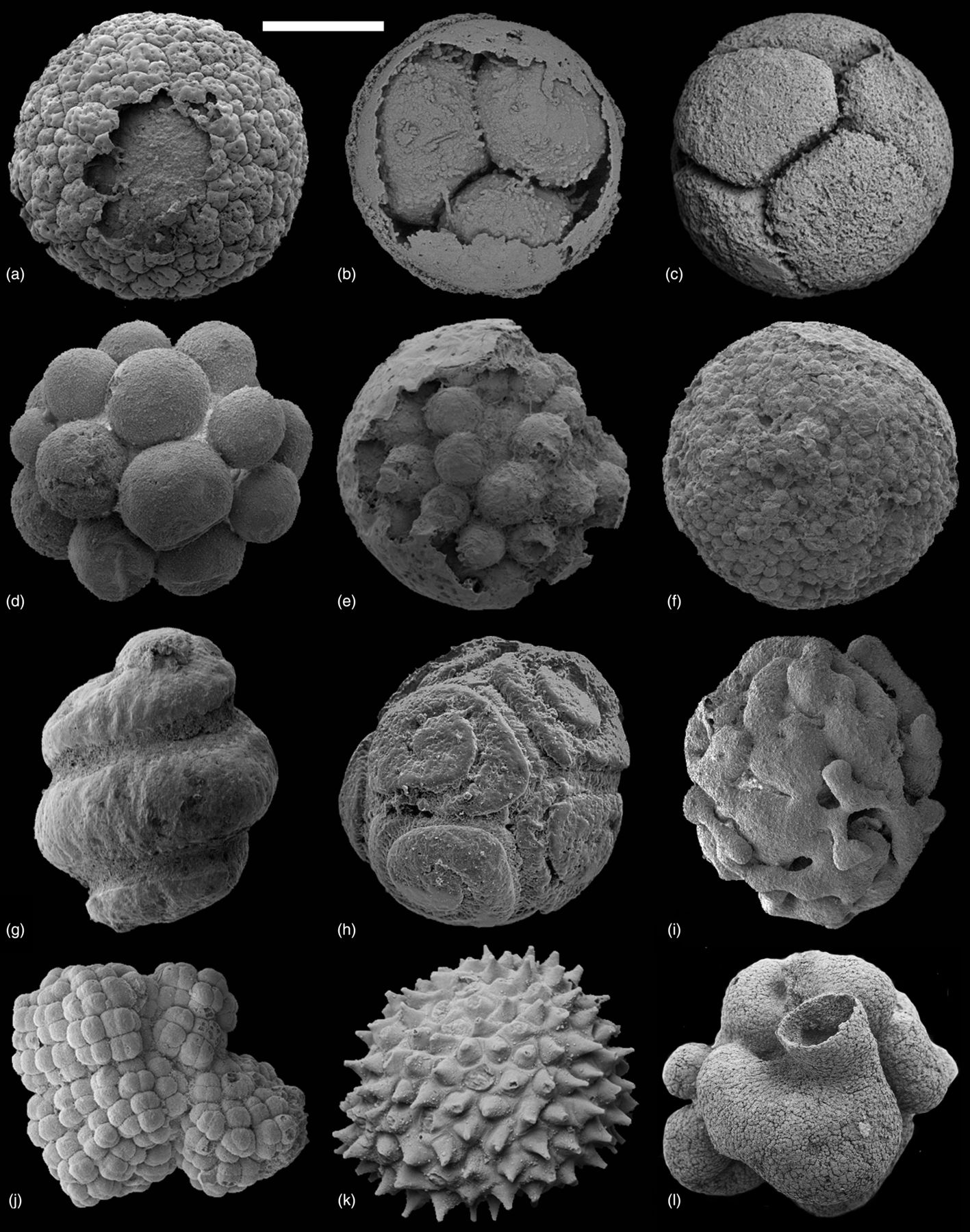
Microscopic fossils that look like dividing embryos. But might be giant bacteria; sparking a 20-year debate about the origins of animal development.
John A. Cunningham, Kelly Vargas, Zongjun Yin, Stefan Bengtson and Philip C. J. Donoghue, CC BY 3.0
The animal ancestor in the stone
In the phosphorite mines of Guizhou Province, China, paleontologists found something unexpected: microscopic spheres, barely half a millimeter wide, that appeared to be the fossilized embryos of the earliest animals. Discovered within the Doushantuo Formation, these fossils date back to the Ediacaran Period, between 635 and 551 million years ago. This places them in an important window of time, tens of millions of years before the Cambrian Explosion, when most major animal groups suddenly appear in the fossil record.
First described in detail in 1998, the fossils, many identified as Megasphaera, show what look like cells undergoing division. Spheres contain 2, 4, 8, 16, and more cells, consistent with the cleavage patterns of modern animal blastulas—an early embryonic stage. Some specimens even show signs of cell differentiation, where cells take on specialized roles, an important feature of complex multicellular life. For years, these tiny fossils were the strongest physical evidence for animal life existing long before the Cambrian.
The remarkable preservation of these fossils is due to a process called phosphatization. Minerals replaced the delicate cellular structures with calcium phosphate, creating a perfect, three-dimensional snapshot of the organism moments after death. This process allowed scientists to study the internal arrangement of cells and argue for their animal affinity.
A debate over identity
The animal embryo hypothesis soon faced serious challenges. An alternative interpretation emerged suggesting the fossils were not animals at all, but giant, single-celled organisms. One leading candidate is a type of giant sulfur-oxidizing bacteria similar to the modern Thiomargarita. These modern microbes are also spherical, can be macroscopic, and undergo a type of reductive cell division that produces internal spheres, mimicking the appearance of a cleaving embryo.
Further investigation using advanced imaging technology has complicated the picture. Synchrotron-radiation X-ray microtomography (SRXTM) allows scientists to create high-resolution 3D models of the fossils' interiors without destroying them. These scans revealed that many specimens lack the complex internal organization expected of an animal embryo. The dividing "cells" in some fossils appear to be artifacts of mineral growth rather than true biological structures.
None of the thousands of fossils found show development beyond the blastula-like stage. There is no evidence of gastrulation, the process where embryonic cells organize into distinct layers that form tissues and organs. This persistent absence of later developmental stages supports the idea that these organisms were not developing animals, but something else entirely—perhaps single-celled protists or bacteria with a different life cycle. The debate continues, with each new study adding to the mystery of these ancient spheres.
💡Fun Facts
The name of the most-debated fossil, *Megasphaera*, simply means "giant sphere."
The Doushantuo Formation's phosphatic preservation is so exceptional it can capture subcellular structures, including what some paleontologists have controversially identified as cell nuclei.
An important fossil site for this controversy is the Weng'an Biota, a specific fossil-rich deposit within the Doushantuo Formation in Guizhou.
The debate has become highly technical, with researchers using advanced geochemical analyses to determine if the environment could have supported animal life and whether the chemical composition of the fossils is consistent with biological tissues.
This is a wide-ranging geological formation with active research sites, not a formal park with public opening hours.
Admission
Not applicable. Access to specific fossil quarries is typically restricted to scientific researchers.
Accessibility
The fossil-bearing rock layers are located in a mountainous, rural province. Access requires navigating difficult terrain and is generally part of organized geological expeditions.