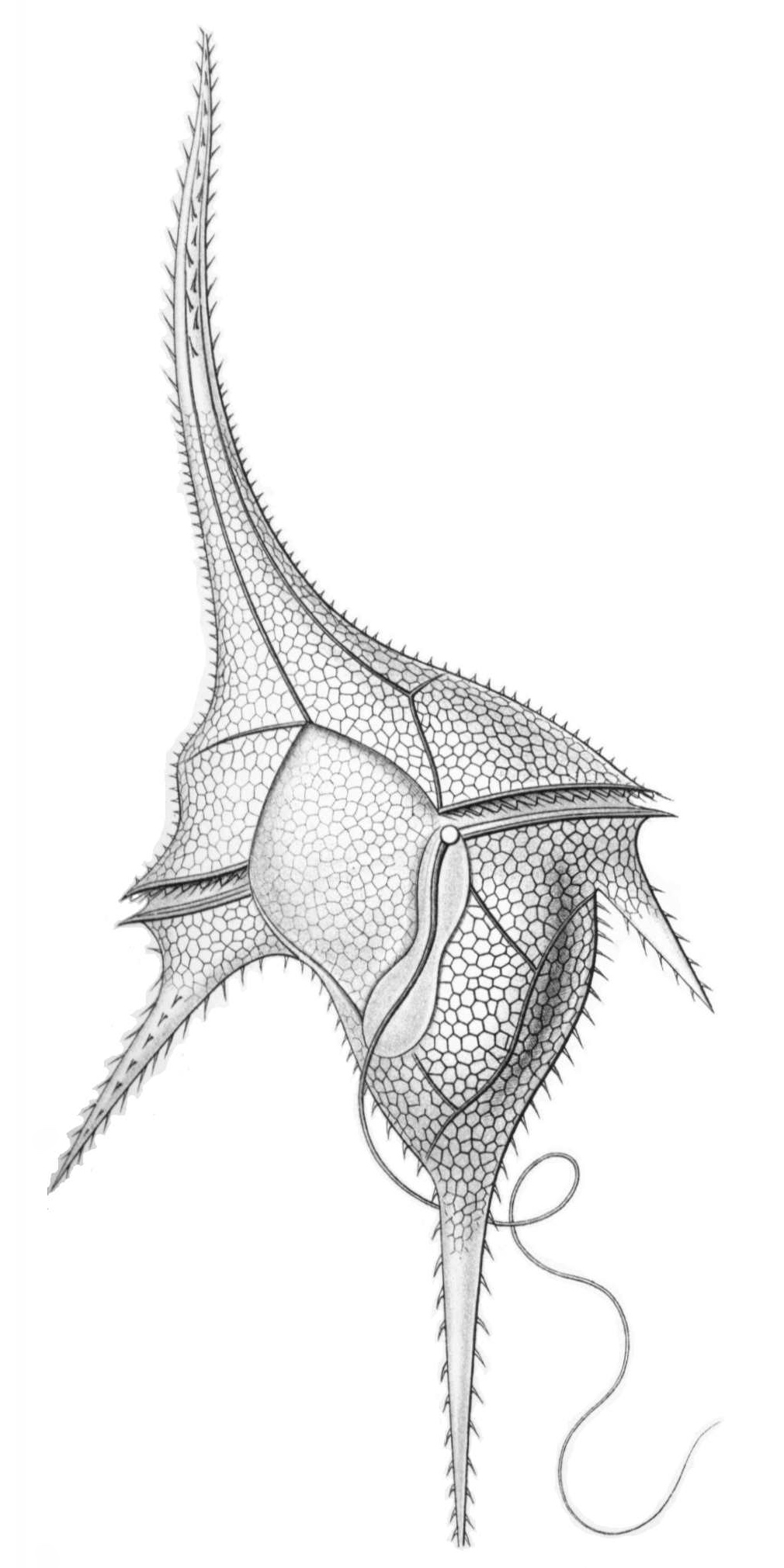
The whirling armored cell
Dinoflagellates are single-celled organisms defined by two whip-like appendages, called flagella, that propel them through the water with a characteristic spin. The name itself comes from the Greek "dinos" for whirling and the Latin "flagellum" for whip. One flagellum wraps around the cell in a groove called the cingulum, providing the spinning motion. The other, the longitudinal flagellum, trails behind and acts as a rudder. Many species are "armored," possessing a complex cell covering called a theca. This armor is not a single shell but a complex structure of interlocking cellulose plates held within vesicles just beneath the cell membrane.
Inside, the dinoflagellate nucleus is highly unusual. Called a dinokaryon, its chromosomes remain permanently condensed throughout the cell's life cycle. Unlike almost all other eukaryotes, the DNA in most dinoflagellates is not packaged with histone proteins, giving it a unique structure that some once considered an intermediate state between prokaryotes and eukaryotes. This dense nucleus can contain a massive amount of genetic material, sometimes up to 200 picograms of DNA per cell.
Florida's dual-identity microbes
In the waters of Florida, dinoflagellates display their multiple "superpowers" in dramatic fashion. The most notorious is the Florida red tide, caused by massive blooms of the species Karenia brevis. While not all blooms discolor the water, at high concentrations they can turn the sea reddish-brown or green. K. brevis produces powerful neurotoxins called brevetoxins. When the delicate cells are broken by wave action, these toxins can become airborne, causing respiratory irritation in humans miles inland. In the water, the toxins attack the central nervous systems of marine life, leading to large-scale fish kills and harming sea turtles, birds, and marine mammals like manatees and dolphins.
Other Florida dinoflagellates create light. In the Indian River Lagoon, blooms of Pyrodinium bahamense produce bioluminescence. These organisms flash a blue-green light when mechanically disturbed—by a passing boat, a swimming fish, or a hand swept through the water. The light comes from a chemical reaction involving luciferin and the enzyme luciferase, held within specialized spherical bodies called scintillons. This flash is a defense mechanism, startling predators or illuminating them to attract even larger predators.
The coral's powerhouse
In addition to light and toxic tides, a third group of dinoflagellates is important to the health of Florida's coral reefs. These are the symbiotic algae known as zooxanthellae, primarily from the genus Symbiodinium. They live directly inside the tissue of coral polyps in a mutualistic relationship that has existed for over 140 million years. The algae perform photosynthesis, providing the coral with up to 95% of its energy in the form of sugars and other nutrients. In return, the coral provides the algae with a protected, sunlit environment and compounds like carbon dioxide and nitrogen. This partnership is what allows corals to build their massive calcium carbonate skeletons and create entire reef ecosystems. The bright colors of healthy corals are due to the pigments of these millions of resident dinoflagellates.