A flawed masterpiece
The Cosmic Microwave Background (CMB) is the oldest light in existence, an afterglow from when the universe was just 380,000 years old. This radiation, mapped by space telescopes like COBE, WMAP, and Planck, presents an almost perfectly uniform temperature of 2.725 Kelvin across the entire sky. But "almost" is the point. Embedded in this ancient light are minuscule temperature fluctuations—on the order of 1 part in 100,000—that started the formation of every galaxy we see today.
According to the Standard Model of Cosmology, these temperature variations should be random and statistically the same in all directions. For the most part, they are. Yet, high-precision data reveals several large-scale patterns that are statistically improbable and are hard to explain. These anomalies show that our understanding of the universe might be incomplete.
The Cold Spot and the Great Void
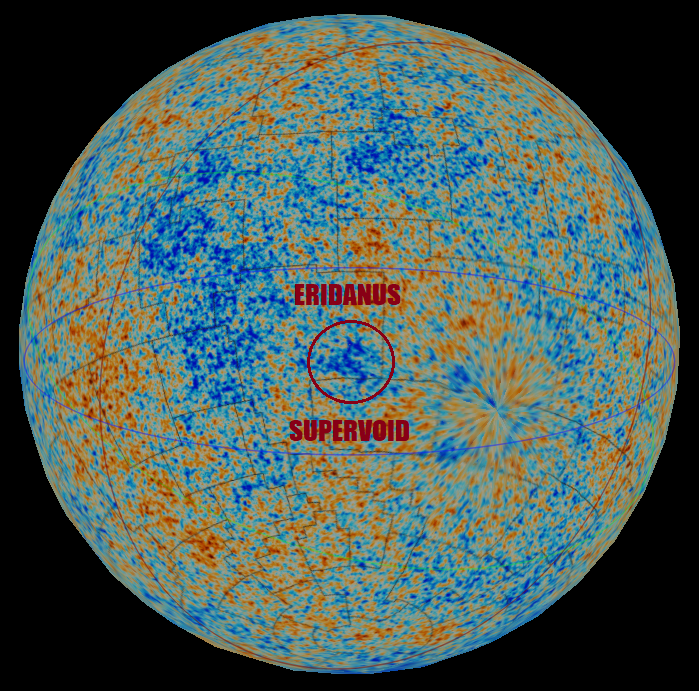
One of the most prominent anomalies is the CMB Cold Spot, a vast patch of sky in the direction of the constellation Eridanus that is unusually large and cold. It spans about 10 full moons across (a 5-degree radius) and is, on average, 70 microkelvins colder than the surrounding CMB. At its center, the temperature plummets to 140 microkelvins below average. The probability of such a large, cold region appearing by chance in the standard model is estimated to be as low as 1 in 2000.
A leading explanation is the presence of an enormous supervoid, a region of space with far fewer galaxies than average. Identified as the Eridanus Supervoid, this structure is estimated to be between 500 million and one billion light-years in diameter. It lies between 6 to 10 billion light-years from Earth. As photons from the CMB travel through this void, they lose energy, which could make the light from that direction appear colder. More speculative theories say the Cold Spot is a "bruise" left from a collision with another universe or a piece of a cosmic texture—a defect in spacetime.
An Axis of Evil and a Lopsided Universe
Other anomalies challenge the fundamental assumption that the universe is isotropic, or the same in all directions. Data reveals a hemispherical power asymmetry: the temperature fluctuations in one half of the sky are about 10% stronger than in the other. This runs counter to predictions that the variations should be broadly similar everywhere.
An even stranger feature is a series of suspicious alignments nicknamed the "Axis of Evil." The largest-scale patterns in the CMB, known as the quadrupole (two hot and two cold lobes) and octopole (a more complex pattern), are aligned with each other to a degree that should not happen randomly. The probability of this alignment occurring by chance is calculated to be less than 0.3%. Compounding the mystery, this axis also aligns with the plane of our own solar system. This coincidence suggests a possible connection between our local neighborhood and the largest structures in the universe, a link that does not fit in current cosmological models. While these could be enormous statistical flukes, they lead scientists to explore physics beyond the standard model.