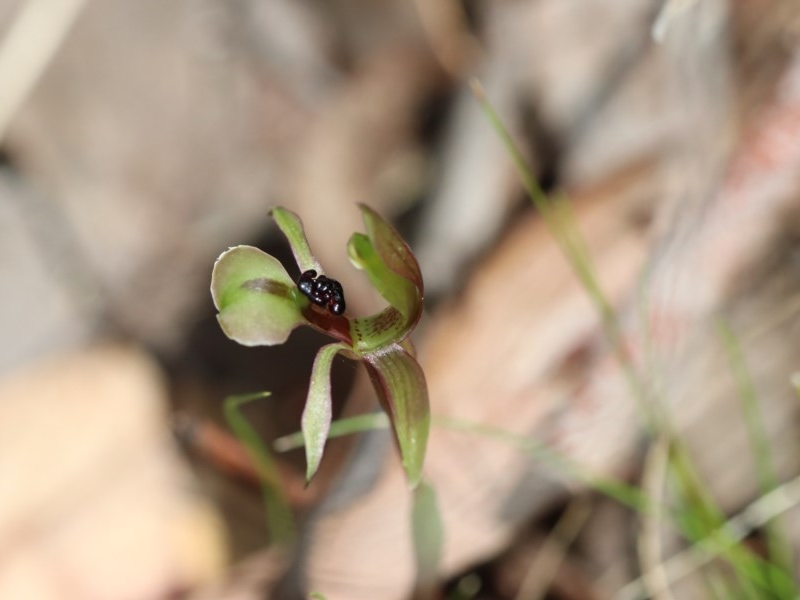
A Deception in the Undergrowth
In the sheltered forests of Victoria, Australia, a small, unassuming orchid engages in an act of remarkable chemical espionage. Chiloglottis trapeziformis, commonly known as the Dainty Bird-orchid, has evolved a pollination strategy of sexual deception. This terrestrial orchid grows in colonies, a perennial herb with two dark green leaves that lie flat on the ground. From this base, a single, slender stem rises 8 to 14 cm, presenting a greenish-brown or purplish flower that is only about 12 to 16 mm long.
The target of its deception is a single species of thynnine wasp, Neozeleboria cryptoides. The orchid's flower features a modified petal, called a labellum, which is diamond-shaped and held erect. This labellum is adorned with a shiny, black, insect-like callus. This physical mimicry is less important than its chemical prowess. The orchid produces and releases a compound that is chemically identical to the sex pheromone emitted by the female N. cryptoides wasp. The male wasp, detecting this scent, is irresistibly drawn to the flower under the impression that he has found a mate.
A Masterclass in Chemical Mimicry
The specific chemical involved in this deception is 2-ethyl-5-propylcyclohexan-1,3-dione. Scientists have given this previously unknown natural product the trivial name "chiloglottone," after the orchid genus. This is not just a similar-smelling compound; it is the exact same molecule the female wasp produces. To the male wasp's antennae, the flower and a female wasp are chemically indistinguishable.
This chemical production is highly localized within the flower. The shiny, black callus on the labellum—the part that visually resembles an insect—is the primary source of the chiloglottone. Lured by this scent, the male wasp lands on the labellum and attempts to copulate with the callus. During this process, known as pseudocopulation, the wasp either picks up the orchid's pollen sacs (pollinia) or deposits pollen from another flower he has visited. After pollination, the flower stem lengthens significantly to aid in seed dispersal. This entire reproductive cycle for the orchid depends on its ability to fool this one specific wasp species. The orchid was first formally described by Robert D. FitzGerald in his 1877 book Australian Orchids.