The extinction layer
In the Southern Peninsula of Haiti, within a sequence of rocks called the Beloc Formation, there is a layer of sediment that records one of the most violent days in Earth's history. This is the Cretaceous-Paleogene (K-Pg) boundary, marking the moment 66 million years ago when an asteroid around 12 kilometers in diameter struck the planet. The impact ended the reign of the dinosaurs and wiped out roughly 70% of all species. What makes the Beloc Formation exceptional is its thick, well-preserved deposit of impact spherules—tiny beads of glass.
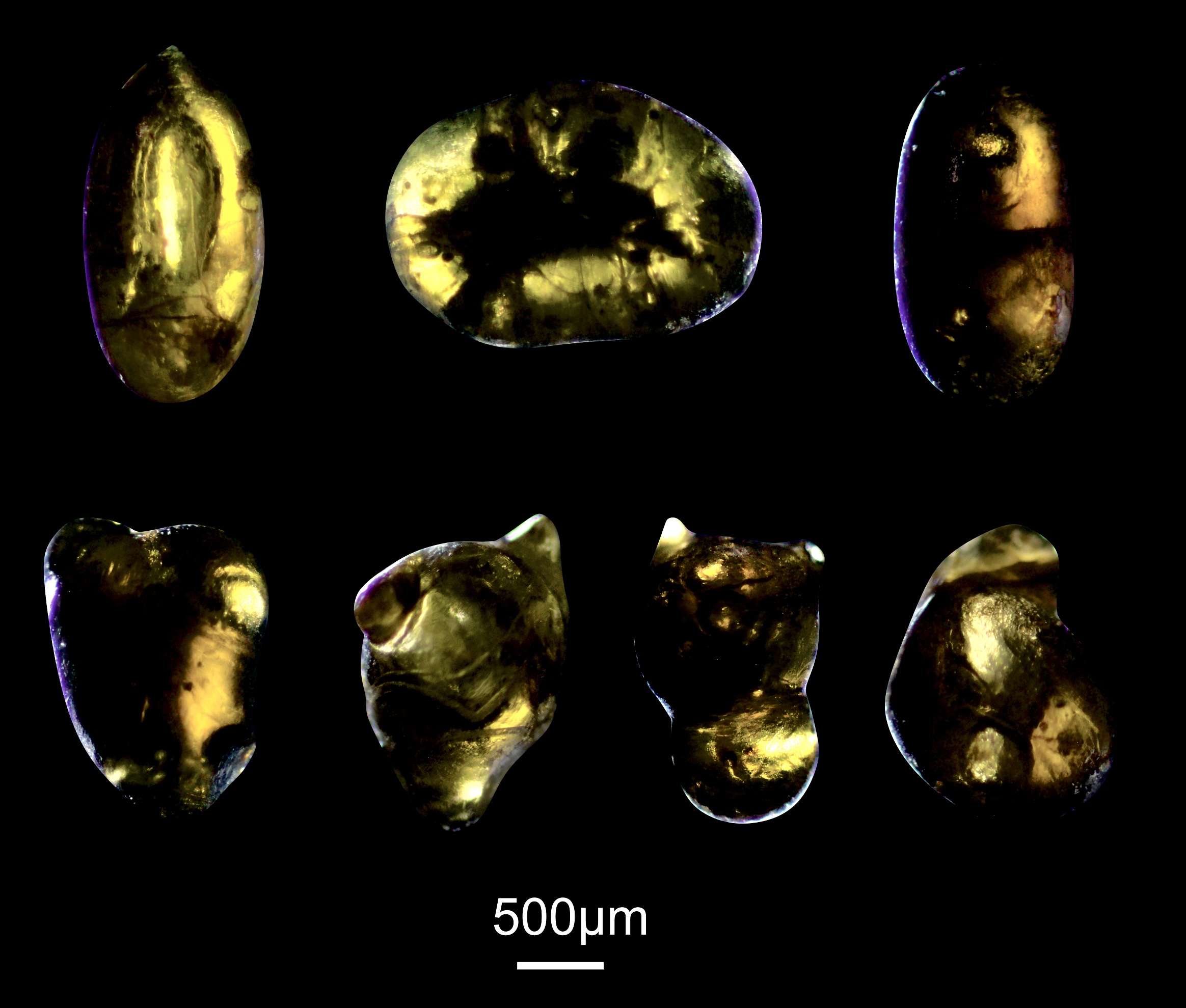
These glass spherules, also known as tektites, are droplets of Earth's crust that were melted and blasted into the atmosphere by the impact's force. The material traveled on ballistic trajectories, cooling and solidifying into glass as it fell back to Earth. Globally, these spherules form a thin layer, but the deposit in Haiti is unusually thick, reaching up to 75 centimeters in some places. This thickness is a direct result of Haiti's relative proximity to the Chicxulub impact crater, which is buried under Mexico's Yucatán Peninsula about 1,200 kilometers away. The spherules found here range from 0.1 to 5 millimeters and appear as black and yellow glass particles. Some retain splash-form shapes like teardrops and dumbbells, a sign of their molten flight through the ancient atmosphere.
The K-Pg boundary layer contains more than glass. It is a composite that records of multiple, simultaneous catastrophes. Mixed with the spherules are grains of shocked quartz, a type of quartz crystal deformed by the immense pressure of the impact. The layer is also famously enriched with the element iridium. Iridium is rare in Earth's crust but much more common in asteroids, and its presence in this layer worldwide was the first major clue that linked the mass extinction to an extraterrestrial impact.
A tsunami of epic proportions
The Beloc deposit contains fallout from the sky. It contains evidence of an almost immediate secondary disaster: a colossal tsunami. The impact, which struck a shallow sea, generated a seismic event estimated to be equivalent to a magnitude 9 to 11 earthquake and a series of megatsunamis. Some models suggest the initial waves near the impact could have reached a height of 1.5 kilometers.
These waves raced across the Gulf of Mexico and the proto-Caribbean. The deposits in Haiti are not a neat sedimentary layer but a jumble, indicating deposition by powerful, turbulent water. The presence of coarse sandstone, plant debris, and other materials suggests the tsunami scoured the seafloor and nearby landmasses, mixing everything into a slurry with the freshly fallen impact spherules. The entire sequence—spherule fallout followed by tsunami deposition—is thought to have occurred within minutes to hours of the impact. This makes the Beloc Formation a remarkably high-resolution snapshot of the chaos that unfolded on the day the world changed forever. Its unique combination of fallout ejecta and tsunami deposits records the event's immediate aftermath.