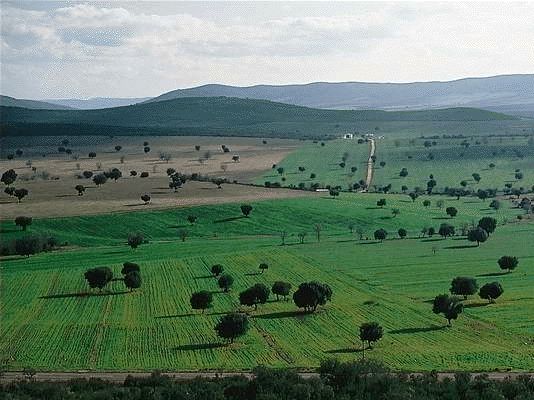
An Accidental Eden
The vast, open savanna of Cabañeros National Park, often called the "Spanish Serengeti," appears to be a timeless, natural landscape. Herds of red deer (Cervus elaphus) graze on plains dotted with ancient holm oaks (Quercus ilex) and cork oaks (Quercus suber). This landscape, however, is not from nature alone. It is an anthropogenic environment, a savanna created and maintained by thousands of years of human activity.
Scientific experiments within the park demonstrate this relationship. In controlled plots where all large herbivores are fenced out, the ecosystem changes rapidly. Without the constant pressure of grazing and browsing, the open grassland is quickly colonized by woody shrubs. Dense thickets of gum rockrose (Cistus ladanifer), heathers (Erica species), and other Mediterranean scrub plants take over. Within just 30 years, the savanna becomes an impenetrable forest, shading out the grasses and herbs that support much of the park's famous wildlife. This proves the open character of the Cabañeros landscape depends on the presence of herbivores.
This dynamic has been at play for millennia. Paleoecological data, including the analysis of ancient pollen and dung fungal spores, shows that this landscape co-evolved with the introduction of domestic livestock. For approximately 6,000 years, since the Neolithic period, cattle and other livestock have shaped this forest, clearing the undergrowth and creating the open, park-like environment known as a dehesa.
A Landscape of High Biodiversity
Though human-made, the savanna of Cabañeros has high biodiversity. The park, which covers 40,856 hectares, supports many life adapted to this specific habitat. It is a Special Protection Area for birds and hosts over 276 species of birds and 45 mammal species.
The park is a refuge for some of Europe's most threatened raptors. It hosts one of the world's largest breeding colonies of the cinereous vulture (Aegypius monachus), with over 200 breeding pairs recorded. The endangered Spanish imperial eagle (Aquila adalberti) also nests in the ancient oaks. The open grasslands provide essential hunting grounds for these large birds of prey, which would be unable to thrive in a dense forest.
The mammal population includes large herds of red deer, roe deer, and wild boar. The park is also part of a reintroduction program for the critically endangered Iberian lynx (Lynx pardinus), which relies on the mosaic of open areas and scrub for hunting its primary prey, the European rabbit. The entire ecosystem, from the rare carnivorous plant Drosera rotundifolia found in the park's peat bogs to the top predators, is sustained by a landscape actively managed by grazing animals.