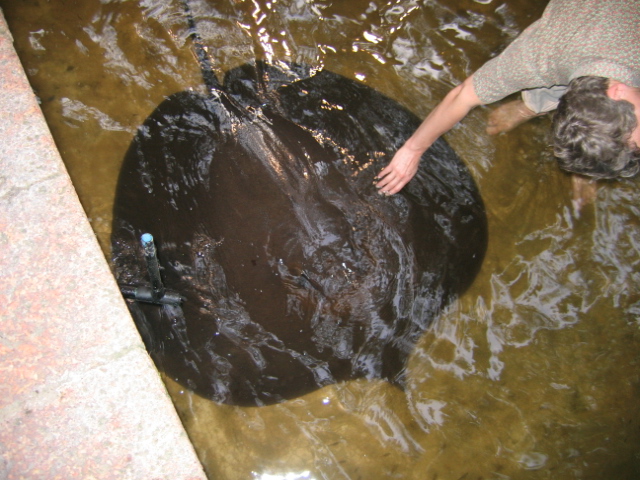
Marine stingrays that colonized rivers and evolved into separate species. They've lost their salt tolerance in just 10,000 years, showing rapid evolutionary change.
Barry Rogge, CC BY 2.0, via Wikimedia Commons
An Accidental Invasion
During the Pleistocene epoch, better known as the last ice age, global sea levels were up to 120 meters lower than they are today. This drop in sea level exposed a massive landmass in Southeast Asia called the Sunda Shelf, which connected Borneo, Sumatra, Java, and the Malay Peninsula into a single contiguous continent known as Sundaland. Vast river systems, much larger than those of today, crisscrossed this plain. Marine stingrays from the family Dasyatidae, ancestors of modern species like the giant freshwater stingray (Urogymnus polylepis), ventured into these enormous freshwater estuaries and river basins.
These ancient rivers, including the massive North Sunda River System, were ecological corridors. For thousands of years, the stingrays could move between saltwater and freshwater environments. However, as the ice age ended around 14,000 years ago, a dramatic meltwater pulse caused sea levels to rise rapidly. The Sunda Shelf flooded, drowning the ancient river systems and turning Sundaland into the archipelago we see today. This event trapped populations of stingrays in the newly isolated river basins of Borneo, such as the Mahakam and Kapuas rivers. What was once a temporary habitat became a permanent prison, leading to for rapid evolution.
Losing the Past
Trapped in freshwater, the stingrays faced an immense physiological challenge. Marine elasmobranchs (sharks and rays) maintain a delicate internal balance with the salty ocean. They keep high concentrations of urea and other organic solutes in their blood to match the salinity of seawater, preventing dehydration. In freshwater, this system becomes a liability. The now-higher internal salt and urea concentration causes a massive influx of water into the stingray's body, a potentially fatal osmotic problem.
The isolated Borneo stingray populations underwent remarkable and swift evolutionary changes to survive. Over just 10,000 years, they completely re-engineered their osmoregulation systems. The ability to produce and retain large amounts of urea was lost. The rectal gland, a specialized organ used by their marine ancestors to excrete excess salt, became reduced and non-functional. Their kidneys adapted to become highly efficient at retaining salts and expelling enormous quantities of water. This physiological transformation was so complete that these species became stenohaline—they are now strictly confined to freshwater and have lost the ability to survive in the saltwater environments of their ancestors. This rapid adaptation shows evolution in response to environmental change.
💡Fun Facts
The freshwater stingrays of Southeast Asia evolved independently from the famous freshwater stingrays of South America's Amazon basin (family Potamotrygonidae), a classic example of convergent evolution.
The giant freshwater stingray, *Urogymnus polylepis*, found in Borneo's rivers, is one of the largest freshwater fish in the world, potentially reaching 2.2 meters in width and weighing over 300 kg.
To hunt for invertebrates buried in the riverbed mud, these stingrays use electroreception through organs called ampullae of Lorenzini, which detect the faint electrical fields of their prey.
The transition to freshwater was so successful that there are at least 14 species of dasyatid rays known to live in or enter the freshwater habitats of Southeast Asia.
The rivers of Kalimantan are always accessible, but best visited during the dry season (June to October). Guided river tours are necessary.
Admission
Access to the rivers is free, but guided tours into national parks like Tanjung Puting or along the Mahakam River have costs.
Accessibility
Travel is almost exclusively by boat, ranging from traditional "klotok" houseboats to speedboats. Accessibility is limited for those with mobility issues.