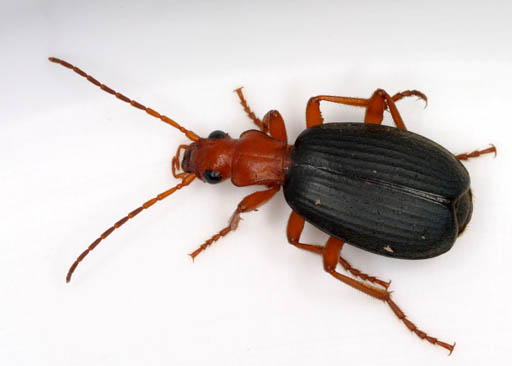
Detailed studies show the beetle's explosion chamber has a special coating that prevents it from being burned by its own 100°C defensive spray. The chemical reaction happens so fast (in milliseconds) that it requires precise muscular control.
Patrick Coin (Patrick Coin), CC BY-SA 2.5, via Wikimedia Commons
A two-chamber chemical weapon
The bombardier beetle, a name covering over 500 species in the family Carabidae, possesses one of nature's most volatile defense mechanisms. Located at the tip of its abdomen are two glands, each containing a sophisticated two-chambered apparatus. The first, a flexible reservoir, holds an aqueous solution of hydroquinones and hydrogen peroxide. The second, a thick-walled reaction chamber, is lined with secretory cells that produce a mix of enzymes, specifically catalases and peroxidases.
When the beetle is not threatened, these two sets of chemicals remain safely separated by a valve. The reservoir can store enough reactants for the beetle to fire its weapon roughly 20 times before needing to replenish its supply. The entire system is an example of extreme biological development, allowing the beetle to manage a controlled chemical explosion within its own body. These beetles are carnivorous and are found on every continent except Antarctica, typically in woodlands and grasslands.
An explosive, high-speed discharge
When a bombardier beetle perceives a threat, such as an ant, spider, or frog, it initiates a rapid sequence of events. Muscles surrounding the reservoir contract, forcing the hydrogen peroxide and hydroquinone solution through the valve and into the reaction chamber. The instant the reactants mix with the enzymes, a violent exothermic reaction occurs. The catalases and peroxidases act as catalysts, rapidly decomposing the hydrogen peroxide into water and oxygen gas, while oxidizing the hydroquinones into caustic p-quinones.
This reaction heats the mixture to approximately 100°C (212°F). The liberated oxygen gas creates immense pressure, which forces the boiling liquid out through an opening at the beetle's rear with an audible "pop". The ejection is not a continuous stream but a series of rapid pulses. High-speed imaging has shown that the beetle can produce around 500 to 700 pulses per second. This pulsed mechanism is caused by the explosive pressure repeatedly forcing the inlet valve closed, which protects the beetle's internal organs from the blast. The beetle can also aim its spray with remarkable accuracy, sometimes rotating the tip of its abdomen to direct the jet at an attacker.
💡Fun Facts
The explosive discharge sounds like a distinct pop, which can further startle predators.
Some bombardier beetles can aim their defensive spray in a wide range of directions, even forward over their own heads.
The beetle's pulsed-jet mechanism has been studied by engineers as a potential model for new types of propulsion and spray-delivery systems.
The primary irritant in the spray is benzoquinone, a chemical that is also used in some topical skin medications for humans.