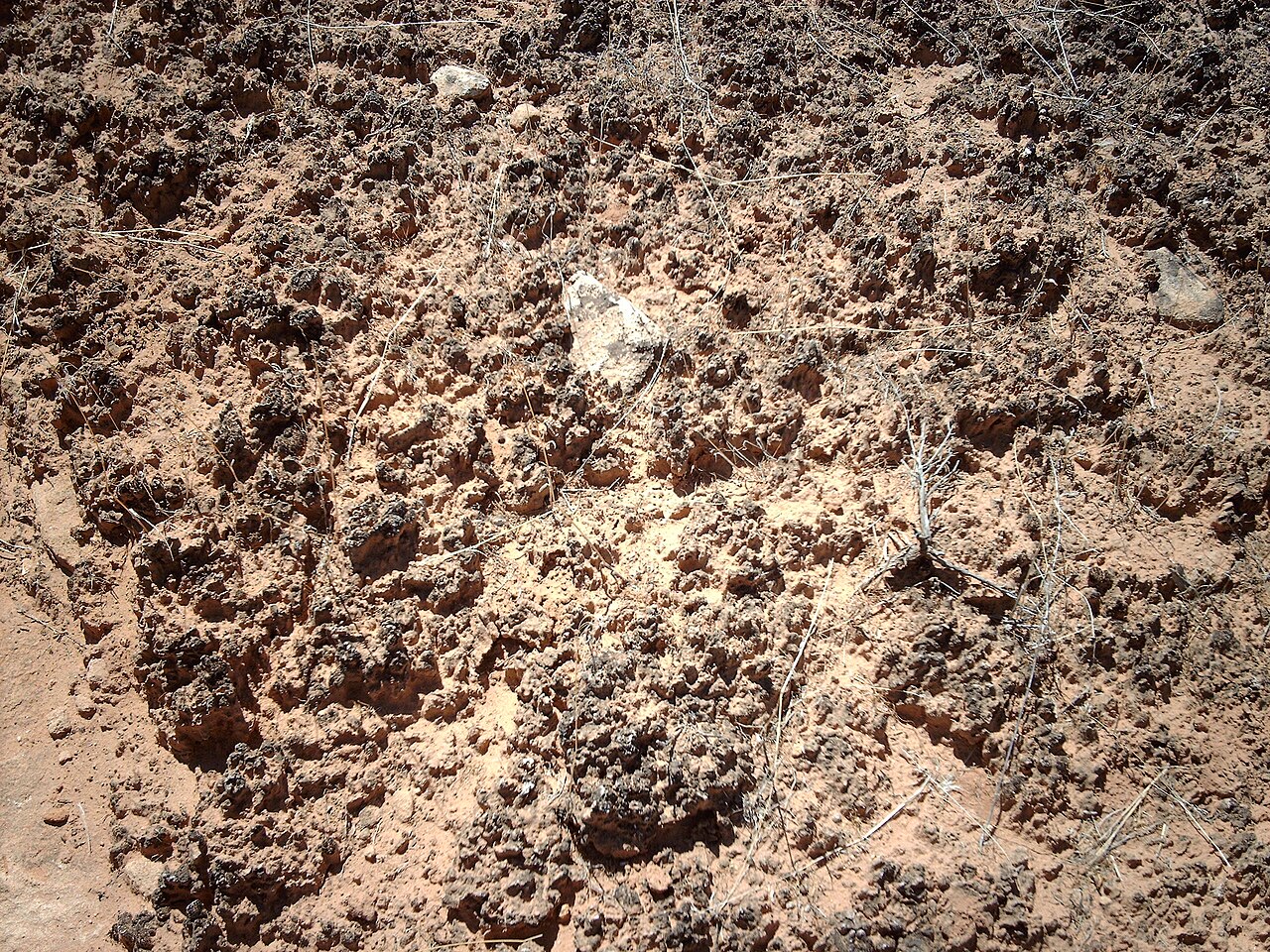
Biological soil crusts fixing nitrogen in the desert. Metagenomic analysis shows cyanobacteria in the crust capture nitrogen equivalent to 20 kg per hectare per year, fertilizing the entire ecosystem.
Original uploaded by Nationalparks (Transferred by Nihonjoe), CC BY-SA 2.5, via Wikimedia Commons
The living skin of the steppe
The Betpak-Dala, or "Hungry Steppe," is a vast desert of around 75,000 square kilometers in central Kazakhstan. Its landscape is a harsh, rolling plain with a sharply continental climate—summers are hot and dry, while winters are cold with little snow. Annual precipitation is a mere 100-150 millimeters. In this arid environment, the ground between sparse shrubs is not bare; it is covered by a living community of organisms called a biological soil crust, or biocrust.
These crusts are a consortium of cyanobacteria, lichens, algae, mosses, and fungi that inhabit the top few millimeters of soil. They often appear as a dark, bumpy layer on the ground, a coloration that comes from the UV-protective pigments produced by the cyanobacteria. The organisms bind soil particles together, creating a stable matrix that resists wind and water erosion. Disturbance from vehicles or livestock can produce up to 36 times more sediment movement than on crusted soil. The filamentous growth of cyanobacteria and fungi physically entangles soil particles, further consolidated by glue-like polysaccharide secretions. This structure also increases the soil's ability to absorb and retain scarce water.
A microscopic nitrogen factory
Desert ecosystems are often limited by low levels of nitrogen, a necessary nutrient for plant growth. The biocrusts of Betpak-Dala perform a function that is important to the entire ecosystem's survival: nitrogen fixation. Certain cyanobacteria within the crust take nitrogen gas (N2) from the atmosphere and convert it into ammonia and other nitrogen compounds that plants can use. Soils with biological crusts can contain up to seven times more nitrogen than similar soils without them.
Metagenomic analysis, which sequences the DNA from the entire community, reveals the specific microbes responsible. While the non-nitrogen-fixing cyanobacterium Microcoleus vaginatus is often a dominant pioneer species that organizes the community, it creates a "cyanosphere" around itself that is rich in other nitrogen-fixing bacteria. This relationship is a form of mutualism, where M. vaginatus provides carbon and other microbes provide fixed nitrogen. This microscopic community is a self-sustaining fertilizer factory, contributing the equivalent of 20 kg of nitrogen per hectare annually. This natural fertilization supports the wormwood, saxaul, and other hardy plants in the Betpak-Dala flora.
💡Fun Facts
Biological soil crusts are found on every continent, covering an estimated 12% of the Earth's land surface.
The filaments of cyanobacteria can form sheaths that remain in the soil long after the organism is dead, continuing to bind soil particles to a depth of 10 cm.
When dry, the organisms in the crust are dormant, but they can become metabolically active again within minutes of receiving water.
Recovery of a disturbed crust is extremely slow, taking many years or even millennia to reform naturally.
The Betpak-Dala is an extremely remote and sparsely populated wilderness. Access requires a suitable 4x4 vehicle, extensive supplies, and local guidance. There are no paved roads or tourist facilities.